|
|
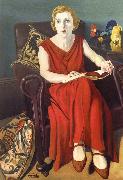 |
Cagnaccio di San Pietro
|
|
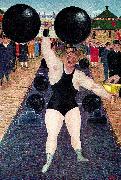
Italian, 1897-1946,born Natale Bentivoglio Scarpa, was an Italian magic realist painter. He had his artistic training at the Academy of Fine Art in Venice, where he studied under Ettore Tito. Cagnaccio's early paintings were in a Futurist idiom, but by the early 1920s he had adopted a very smoothly brushed, nearly photographic style. His work, which includes portraits, nudes, still lifes, scenes of popular life, and religious pictures, shows the influence of the German painters of the New Objectivity. One of his best-known paintings, After the Orgy (1928) shows three nude women asleep on a floor littered with wine bottles, playing cards and cigarettes. |
|
|
|
Caillebotte, Gustave
|
|
French Impressionist Painter, 1848-1894
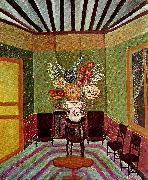
.French painter and collector. Caillebotte's parents, of Norman descent, were wealthy members of the Parisian upper middle class, and his paintings often evoke his family background. After studying classics at the Lyc?e Louis Le Grand, he obtained a law degree in 1870, and during the Franco-Prussian War he was drafted into the Seine Garde Mobile (1870-71). He joined L?on Bonnat's studio in 1872 and passed the entrance examination for the Ecole des Beaux-Arts on 18 March 1873. The records of the Ecole make no mention of his work there, and his attendance seems to have been short-lived. He was very soon attracted by the innovative experiments, against academic teaching, of the young rebels who were to become known as the Impressionists. In 1874 Edgar Degas, whom Caillebotte had met at the house of their mutual friend Giuseppe de Nittis, asked him to take part in the First Impressionist Exhibition at the Nadar Gallery in the Boulevard des Capucines in Paris. However, it was only at the time of their second exhibition in April 1876 that, at Auguste Renoir's invitation, Caillebotte joined the Impressionist group. From then on he was one of the most regular participants in their exhibitions (1877, 1879, 1880, 1882). He organized the show of 1877 and made great efforts to restore the cohesion of the group by persuading Claude Monet to exhibit in 1879. |
|
|
|
|
|
|
|
 |
Callisto Piazza
|
|
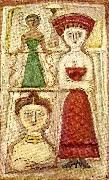
(1500-1561) was an Italian painter.
Callisto, a member of the Piazza family of painters, was born in Lodi, Lombardy.
In 1523 he was working in Brescia. His first dated and signed work is from the following year, and shows a typical Brescian style. This style was then emerging, and included artists such as Romanino and Moretto. Piazza shows influences from contemporaries such as Dosso Dossi and Ludovico Mazzolino of the Ferrarese school, as well as Giovanni Agostino da Lodi.
In 1526-1529 Piazza worked in Val Camonica, at Erbanno, Borno, Breno, Esine and Cividate Camuno. In 1529 he returned to his native Lodi where he formed a workshop with his brothers Cesare and Scipione (died 1552). In 1538, while in Crema, he married the noblewoman Francesca Confalonieri. Later Callisto moved to Milan, where he received numerous commissions, such as the decoration of the San Girolamo chapel in Santa Maria Presso San Celso (1542); the decoration of the refectory of the convent of Sant'Ambrogio (1545); the frescoes for the Saletta Negra in the Castello Sforzesco; and the decoration of the Simonetta chapel in San Maurizio al Monastero Maggiore (1555), largely executed with the assistance of his son Fulvio. He also worked in Lodi at the Incoronata (1454), Novara, at the Abbey of Chiaravalle and other areas of Lombardy.
|
|
 |
CALRAET, Abraham van
|
|
Dutch painter, Dordrecht school (b. 1642, Dordrecht, d. 1722, Dordrecht)
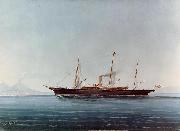
Dutch painter. He was the eldest son of Pieter Jansz. van Calraet (c. 1620-81), a sculptor from Utrecht. According to Houbraken, Abraham was taught by the Dordrecht sculptors Aemilius and Samuel Huppe, although nothing is known of his activity as a sculptor. Houbraken also stated that Abraham learnt to paint figures and fruit and that his brother Barent van Calraet (1649-1737), who specialized at first in horse paintings but later imitated the Rhine landscapes of Herman Saftleven, was a pupil of Aelbert Cuyp (see CUYP, (3)). The known signed works by Barent confirm this. A painting of two horses in a stable, initialled APK (Rotterdam, Mus. Boymans-van Beuningen), indicates that Abraham, too, must have been well acquainted with Cuyp and provides the basis for identifying Abraham's painting style. A large number of landscapes with horses, paintings of livestock in stables and still-lifes, all initialled A.C. and formerly attributed to Aelbert Cuyp, |
|
 |
Calvaert, Denys
|
|
Flemish, 1540-1619
Flemish painter and draughtsman, active in Italy. In 1556-7 he was inscribed in the registers of the painters' corporation in Antwerp as a pupil of the landscape painter Kerstiaen van Queboorn (1515-78). Calvaert went to Bologna c. 1560, where he was to remain for the rest of his life. There he came under the protection of the influential Bolognini family and entered the workshop of Prospero Fontana the elder. After about two years he left Fontana to work with Lorenzo Sabatini, with whom he collaborated on several pictures, including the Holy Family with the Archangel St Michael (Bologna, S Giacomo Maggiore) and an Assumption (Bologna, Pin. N.). Calvaert's oeuvre is composed almost exclusively of religious works, ranging in size from vast altarpieces to small devotional pictures on copper. This sets him apart from other Netherlandish painters, notably those of the school of Prague, for whom Classical mythology was a constant source of inspiration. His first signed and dated work was Vigilance (1568; Bologna, Pin. N.); thereafter he developed a more original style, as in the Noli me tangere (Bologna, Pin. N.). |
|
 |
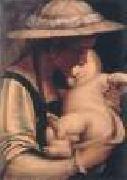
CAMASSEI, Andrea
|
|
Italian painter, Roman school (b. 1602, Bevagna, d. 1649, Roma)
Andrea Camassei (1602-1649) was an Italian painter of the Baroque, who was mainly active in Rome under the patronage of the Barberini. He was born in Bevagna. He was active in painting in the Palazzo Barberini as well as in Antonio Barberini's favored church, Santa Maria della Concezione, where he painted the Assumption of the Virgin on the dome. His training was under Domenichino, but he also labored under the direction of Sacchi and Pietro da Cortona. He painted a Triumph of Constantine for the Baptistery of the Lateran Palace. He painted for the Taddeo Barberini, two large canvases (1638-39) depicting Massacre of the Niobids and Hunt of Diana. He also painted a Saints Bonaventura, Bernardino & Ludovico da Tolosa for Santa Caterina in Rapecchiano (Spello). |
|
 |
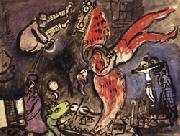
CAMBIASO, Luca
|
|
Italian Mannerist Painter, 1527-1585
1527?C85, leading Italian painter and sculptor of the Genoese school, known also as Luchetto da Genova; son and pupil of Giovanni Cambiaso, a fresco painter. His inventiveness and facile execution in both oil and fresco won him early recognition. His best works are in churches and palaces of Genoa and vicinity. In 1583 he went to Spain, where he worked on the decoration of the Escorial. |
|
|
|
|
|
 |
camille corot
|
|
Paris 1796-Paris 1875 Corot's students included Alfred Sisley, Camille Pissarro, Berthe Morisot, Stanislas Lepine, Adolphe Appian and Dagnan-Bouveret. French painter, draughtsman and printmaker. After a classical education at the Coll?ge de Rouen, where he did not distinguish himself, and an unsuccessful apprenticeship with two drapers, Corot was allowed to devote himself to painting at the age of 26. He was given some money that had been intended for his sister, who had died in 1821, and this, together with what we must assume was his family's continued generosity, freed him from financial worries and from having to sell his paintings to earn a living. Corot chose to follow a modified academic course of training. He did not enrol in the Ecole des Beaux-Arts but studied instead with Achille Etna Michallon and, after Michallon's death in 1822, with Jean-Victor Bertin. Both had been pupils of Pierre-Henri Valenciennes, and, although in later years Corot denied that he had learnt anything of value from his teachers |
|
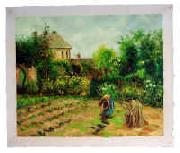 |
Camille Pissaro
|
|
1830-1903
French
Camille Pissarro Locations
Painter and printmaker. He was the only painter to exhibit in all eight of the Impressionist exhibitions held between 1874 and 1886, and he is often regarded as the father of the movement. He was by no means narrow in outlook, however, and throughout his life remained as radical in artistic matters as he was in politics. Thadee Natanson wrote in 1948: Nothing of novelty or of excellence appeared that Pissarro had not been among the first, if not the very first, to discern and to defend. The significance of Pissarro work is in the balance maintained between tradition and the avant-garde. Octave Mirbeau commented: M. Camille Pissarro has shown himself to be a revolutionary by renewing the art of painting in a purely working sense; at the same time he has remained a purely classical artist in his love for exalted generalizations, his passion for nature and his respect for worthwhile traditions.
|
|
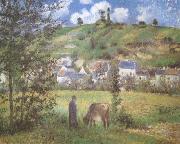 |
Camille Pissarro
|
|
Caribbean-born French Pointillist/Impressionist Painter, ca.1830-1903
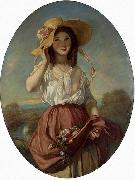
.Painter and printmaker. He was the only painter to exhibit in all eight of the Impressionist exhibitions held between 1874 and 1886, and he is often regarded as the 'father' of the movement. He was by no means narrow in outlook, however, and throughout his life remained as radical in artistic matters as he was in politics. Thad?e Natanson wrote in 1948: 'Nothing of novelty or of excellence appeared that Pissarro had not been among the first, if not the very first, to discern and to defend.' The significance of Pissarro's work is in the balance maintained between tradition and the avant-garde. Octave Mirbeau commented: 'M. Camille Pissarro has shown himself to be a revolutionary by renewing the art of painting in a purely working sense; |
|
 |
Camille Roqueplan
|
|
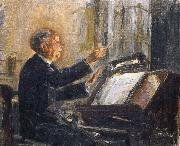
Camille Joseph Etienne Roqueplan, 18 February 1802 in Mallemort; † 30 September 1855 in Paris) was a French painter.
|
|
 |
camille saint
|
|
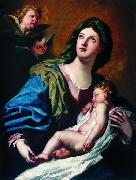
Period: Post-Romantic (1870-1909)
Country: France
Born: October 09, 1835 in Paris, France
Died: December 16, 1921 in Algiers, Algeria
Genres: Chamber Music, Choral Music, Concerto, Keyboard Music, Miscellaneous Music, Opera, Orchestral Music, Symphony
|
|
|
|
 |
Camillo Procaccini
|
|
(1551 - August 21, 1629) was an Italian painter. He has been posthumously referred to as the Vasari of Lombardy, for his prolific Mannerist fresco decoration.
Born in Bologna, he was the son of the painter Ercole Procaccini the Elder, and older brother to Giulio Cesare and Carlo Antonio, both painters.
In 1587 he distinguished in the fresco decoration of the Basilica della Ghiara in Reggio Emilia. In the late 1580s he moved to Milan, where count Camillo Visconti Borromeo commissioned him the decoration of his villa in Lainate. The organ shutters for the Cathedral of Milan were painted after 1590 by Camillo, Giuseppe Meda (died 1599), and Ambrogio Figino. His other works of note include the frescoes of the nave and the apse of the Cathedral of Piacenza in collaboration with Ludovico Carracci (1605 - 1609), and the vault and choir in Santi Paolo e Barnaba of Milan. Also famous is a Nativity in the Sacro Monte d'Orta. Among his pupils is Carlo Biffi.
Among his many other works are a Martyrdom of St. Agnes painted in fresco in the sacristy of Milan cathedral; a Madonna and Child painted for the church of Santa Maria del Carmine; an 'Adoration of the Shepherds found in the Brera; and the ceiling of the church of Padri Zoccolanti, representing the Assumption of the Virgin. eall in the same city. He also painted a Last Judgment for the church of San Prospero at Reggio; He painted a St. Roch administering the Sacrament to the Plague-stricken.
|
|
 |
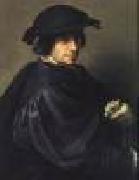
CAMPEN, Jacob van
|
|
Dutch Baroque Era Painter, 1595-1657
Chief exponent of Classicism in The Netherlands. He studied architecture in Italy and was influenced by the work of Scamozzi and Palladio. With his Coymans House on the Keizersgracht, Amsterdam (1624), he introduced the Palladian style to The Netherlands. His most refined work is the Mauritshuis in The Hague (1633?C5), which has a Palladian plan, elevations featuring a Giant Order of Ionic pilasters set on a plain base, a pedimented central section given little emphasis, and a hipped roof. Much grander is the Town Hall (now Royal Palace), Amsterdam (1648?C55): it has two internal courtyards separated by a huge central hall, façades with two superimposed Giant Orders of pilasters, and a large projecting pedimented central section over which is a domed lantern. His Nieuwe Kerk (New Church), Haarlem (1645?C9), is based on the quincunx plan (essentially a Greek cross within a square), with square Ionic crossing-piers and a groin-vault over the crossing. He was responsible for the Accijnshuis, Amsterdam (1638), the Noordeinde Palace, The Hague (1640), and, with others, the decorations of Post's Huis-den-Bosch, Maarssen, near Utrecht (c.1628). |
|
 |
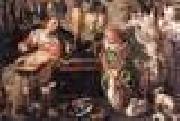
CAMPI, Giulio
|
|
Italian Painter, ca.1502-1572
The eldest of a family prominent painters, Campi was born at Cremona. His father Galeazzo (1475-1536) taught him the first lessons in art.
In 1522, in Mantua, he studied painting, architecture, and modelling under Giulio Romano. He visited Rome, became an ardent student of the antique, and like Bernardino ?? distantly related to him ?? he combined a Lombard and Roman traditions. He collaborated on some works with Camillo Boccaccino, the son of Boccaccio Boccaccino, with whom Campi may also have received training.
Campi is called the "Ludovico Carracci of Cremona" although he preceded the founder of the Eclectics. When but twenty-seven Giulio executed for the church of Sant' Abbondio his masterpiece, a Virgin and Child with Sts. Celsus and Nazarus, a decoration masterly in the freedom of its drawing and in the splendour of its colour. His numerous paintings are grandly and reverently conceived, freely drawn, vigorously coloured, lofty in style, and broadly handled. He was animated in all his work by a deep piety. Numerous of his fresco works are housed in churches of Cremona, Mantua, Milan and in the church of Saint Margaret's, in his native town. Among his chief works are the Descent from the Cross (S. Sigismondo) at Cremona, and the frescoes in the dome of S. Girolamo at Mantua. An altar-piece in S. Sigismondo and his Labours of Hercules were engraved by the celebrated Ghiso, il Mantovano.
He died in Cremona in 1572.
|
|
 |
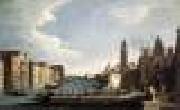
CAMPI, Vincenzo
|
|
Italian Painter, 1536-1591
Vicenzo Campi (c. 1536 - 1591) was an Italian painter of the Renaissance from Cremona.
His style merges Lombard with Mannerist styles, however, unlike his siblings, he is known for a series of canvases, mostly painted after 1570s , displaying genre scenes and local produce. At the time, this type of paintings were uncommon in Italy, and more common in Netherlands, as exemplified by the canvases of Joachim Beuckelaer.
In Cremona, his extended family was the main artistic studio of his time. Giulio Campi and Antonio Campi were reportedly half-brothers, while Bernardino Campi was a distant relative. All were active and prominent local painters. In 1586-1589, he and his brother Antonio completed paintings for the church of San Paolo Converso in Milan. |
|
|
|
|
|
 |
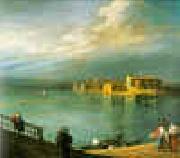
CANAL, Bernardo
|
|
Italian painter, Venetian school (b. 1664, Venezia, d. 1744, Venezia) |
|
 |
Canaletto
|
|
Italian Rococo Era Painter, 1697-1768
Italian painter, etcher and draughtsman. He was the most distinguished Italian view painter of the 18th century. Apart from ten years spent in England he lived in Venice, and his fame rests above all on his views (vedute) of that city; some of these are purely topographical, others include festivals or ceremonial events. He also painted imaginary views (capriccios), although the demarcation between the real and the invented is never quite clearcut: his imaginary views often include realistically depicted elements, though in unexpected surroundings, and in a sense even his Venetian vedute are imaginary. He never merely re-created reality. He was highly successful with the English, helped in this by the British connoisseur JOSEPH SMITH, whose own large collection of Canaletto works was sold to King George III in 1762. The British Royal Collection has the largest group of his paintings and drawings. |
|
 |
Candido Lopez
|
|
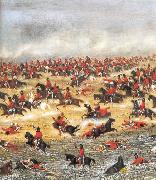
(29 August 1840eDecember 31, 1902) was an Argentine painter and soldier. Born in Buenos Aires, he is considered one of Argentina's most important artists. He is most famous for his detailed paintings and drawings of battles of the War of the Triple Alliance, in which he also fought, losing his right arm. As a result, he learned to paint with his left hand.
He was already a prestigious artist by age seventeen, and had been taught by the exiled Italian Risorgimento artist Baldassare Verazzi. His paintings of battles reflect his love of detail and showy colors that depict the war in miniature. Many of his works are found in the National Fine Arts Museum in Buenos Aires. He is buried in La Recoleta Cemetery, also in Buenos Aires.
|
|
 |
Cano, Alonso
|
|
Spanish, 1601-67
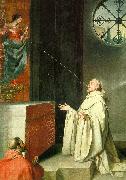
Spanish painter, sculptor and architect. He was an artist of rare versatility in 17th-century Spain, although his architectural work was not extensive. While he is also known for his drawings, only about 60 of these are definitely attributable to him, despite the many extant sketches with the name 'Cano' carelessly added by later hands. Unlike most of his Spanish contemporaries, such as Zurbaren or Velezquez, whose artistic styles did not outlive them, Cano's artistic legacy is measured in part by the number of artists who trained in his workshop and went on to become important masters in their own right: the painters Pedro Atanasio Bocanegra, Juan de Sevilla (1643-95) and, more distantly, Jos Risueo, and the sculptors Pedro de Mena and Jos de Mora, |
|
 |
CANTARINI, Simone
|
|
Italian painter, Bolognese school (b. 1612, Pesaro, d. 1648, Pesaro)
Simone Cantarini (also known as Simone da Pesaro; 12 April 1612 - 1648) was an Italian painter and etcher of the Bolognese School of painting.
Cantarini was born in Oropezza near Pesaro, then part of the Papal States.
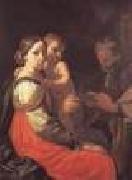
Initially he was a pupil of the Venetian Claudio Ridolfi and Pesarese Giovanni Giacomo Pandolfi, and then, for about 4 years (1635-1639), of Guido Reni. He soon fought with his mentor, and did not return to Bologna till after Reni had died (1642). His pictures are generally derivative. Some of his works have been mistaken for examples of Reni. Among his principal paintings are St. Anthony, at Cagli; the Magdalene, at Pesaro; the Transfiguration in the Brera Gallery, Milan; the Portrait of Guido, in the Bologna gallery; and St. Romuald, in the Casa Paolucci. His most celebrated etching is Jupiter, Neptune and Pluto, honoring the heraldic arms of Cardinal Borghese. |
|
|
|
|
|
|
|
 |
CAPRIOLO, Domenico
|
|
Italian painter, Venetian school (b. 1494, Venezia, d. 1528, Treviso)
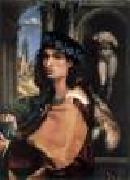
Italian painter. He moved from Venice to Treviso c. 1517, where he is well documented (though there is little about his painting). In 1518-19 he married Camilla, daughter of the painter Pier Maria Pennacchi. A coherent body of work executed between 1518 and 1528 has been reconstructed. Capriolo's first secure work, the Adoration of the Shepherds (Treviso, Mus. Civ.), signed and dated 1518, has a formal structure reminiscent of the late style of Giovanni Bellini, with the broader chromatic range of Palma Vecchio and a crepuscular light that recalls the Venetian works of Giovanni Girolamo Savoldo or Giovanni da Asola ( fl 1512-31). The Assumption in Treviso Cathedral, commissioned in 1520, shows, in its spiralling movement, the influence of the contemporary frescoes of Pordenone in the nearby Malchiostro Chapel. In the Legend of the Doubting Midwife (Treviso, Mus. Civ.), signed and dated 1524, the influence of Savoldo is greater than that of Palma. This is also apparent in the altarpiece of the parish church of Ponzano Veneto (Treviso), dated 1525. The portrait of Lelio Torelli (Barnard Castle, Bowes Mus.), signed and dated 1528, Capriolo's last known work, seems by contrast to reflect local models of portraiture and lies somewhere between the styles of Sebastiano Florigerio and Bernardino Licinio. Other works assigned to Capriolo include: the altarpieces of the parish churches of Cavasagra and Spercenigo, near Treviso; the Adoration of the Shepherds in the sacristy of Serravalle Cathedral at Vittorio Veneto; a fragment of a Nativity (Venice, Mus. Correr); two paintings of the Virgin and Child with Saints (Bucharest, Mus. A.; Conegliano, Mus. Civ. Castello). |
|
 |
CARACCIOLO, Giovanni Battista
|
|
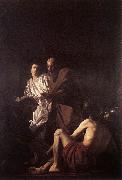
Italian Baroque Era Painter, ca.1578-1635
Italian painter. He was one of the greatest Caravaggesque painters and the founder of Neapolitan Caravaggism. His Liberation of St Peter (c. 1615; Naples, Pio Monte della Misericordia; ) and Christ Washing the Feet of the Disciples (1622; Naples, Certosa di S Martino; see fig. 2 below) are masterpieces of 17th-century Neapolitan art, and attain a powerful and tragic grandeur. |
|
 |
Caravaggio
|
|
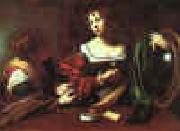
Italian Baroque Era Painter, ca.1571-1610
Italian painter. After an early career as a painter of portraits, still-life and genre scenes he became the most persuasive religious painter of his time. His bold, naturalistic style, which emphasized the common humanity of the apostles and martyrs, flattered the aspirations of the Counter-Reformation Church, while his vivid chiaroscuro enhanced both three-dimensionality and drama, as well as evoking the mystery of the faith. He followed a militantly realist agenda, rejecting both Mannerism and the classicizing naturalism of his main rival, Annibale Carracci. In the first 30 years of the 17th century his naturalistic ambitions and revolutionary artistic procedures attracted a large following from all over Europe. |
|
|
|
 |
CARDUCHO, Vicente
|
|
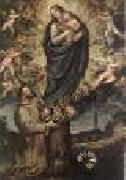
(b. 1576, Florence, d. 1638, Madrid
Painter and theorist, brother of Bartolom Carducho. He became a prolific painter for both the church and the court in Castile, adapting a late 16th-century Italianate style, introduced into Spain in the 1580s, to Spanish themes and settings. After his death this style was superseded in monastic programmes by Zurbarn's pietistic simplicity and in altarpieces and devotional painting by the elegant compositions of van Dyck and Rubens, while Velezquez was unrivalled as a portrait painter. Of more enduring influence than Vicente's paintings, however, was his Dielogos de la pintura (Madrid, 1633), an erudite defence of painting as a noble pursuit and of the artist as a learned humanist. While painters in Spain struggled until the 18th century to attain freedom from artisanship, the Dielogos featured significantly in 17th-century efforts to achieve that goal, |
|
 |
Carel de Moor
|
|
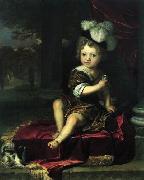
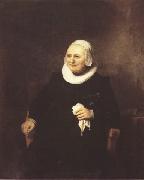
(February 25, 1655 - February 16, 1738) was a Dutch Golden Age etcher and painter. He was a pupil of Gerard Dou.
Carel de Moor was born in Leiden. According to Houbraken, his father was an art dealer who wanted him to study languages and only allowed him to study art when his talent for drawing surfaced at a young age. Houbraken met him in person at the atelier of Godfried Schalcken when he was completing his education there. According to the RKD he was the son of a Leiden painter of the same name and a pupil of Dou, Frans van Mieris, Godfried Schalcken, and Abraham van den Tempel. He became a member of the Leiden Guild of St. Luke in 1683, and became deacon many times over in the years 1688-1711. His own pupils later were Pieter Lyonet, Andrei Matveev, Arent Pijl, Arnout Rentinck, and Mattheus Verheyden.
|
|
 |
Carel fabritius
|
|
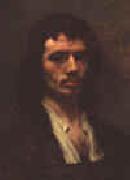
Dutch painter (b. 1622, Middenbeemster, d. 1654, Delft
His oeuvre consists of a scant dozen paintings, since research has rigorously discounted many previously attributed works. These few paintings, however, document the painter's unique development within his brief 12-year career. He is often mentioned as being the link between Rembrandt and the Delft school, |
|
 |
Carel Fabritus
|
|
1622-1654
Dutch
Carel Fabritus Locations
Painter. His oeuvre consists of a scant dozen paintings, since research has rigorously discounted many previously attributed works. These few paintings, however, document the painter unique development within his brief 12-year career. He is often mentioned as being the link between Rembrandt and the Delft school, particularly Pieter de Hooch and Jan Vermeer, whose depiction of light owes much to Fabritius late works in which his use of cool silvery colours to define forms in space marks a radical departure from Rembrandt use of chiaroscuro. |
|
 |
Carel Jacobus Behr
|
|
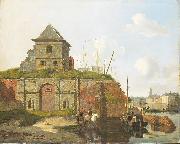
(9 July 1812 in The Hague - 11 November 1895) was a Dutch painter, watercolorist and draftsman. He was a pupil of Bartholomeus Johannes van Hove and mainly painted cityscapes, genre scenes and portraits.
In 1836 he produced, commissioned by The Hague municipal government, an image of the town hall there, which carried off the approval of connoisseurs. In 1837 he became a member of the Royal Academy in Amsterdam. His work is found in various collections and different exhibitions, like at the Hague in 1839, Rotterdam in 1840 and again at the Hague in 1841.
|
|
|
|
 |
CARIANI
|
|
Italian Painter, ca.1490-1547
was an Italian painter of the high-Renaissance, active in Venice and the Venetian mainland, including Bergamo, thought to be his native city. His father, also Giovanni Busi, was born in Fuipiano Valle Imagna and was appointed a local magistrate for the Venetian authorities. His son, probably born in Bergamo, is known to have lived in Venice starting in 1509, and may have trained with either Giovanni Bellini or Giorgione, and almost certainly was influenced by them. Though he worked often in Bergamo, he died in Venice in 1547. He was strongly influenced by Palma il Vecchio, but had a provincial love of scenery as seen in his Sacra conversazione with a youthful donor. While working in Bergamo (1517-1523), |
|
 |
Carl Bille
|
|
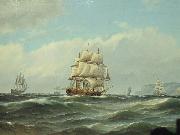
painted Shipping off the Norwegian Coast in 1889 |
|
 |
Carl Blechen
|
|
German Romantic, 1798-1840
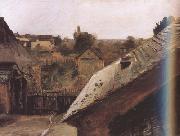
was a German painter, specializing in fantastic landscapes, sometimes with demons and grotesque figures. Born in Cottbus, he drew the attention of prominent architect Karl Friedrich Schinkel, who cast him as a decorative painter. Blechen however aimed for higher work and began producing landscape paintings. In 1827 he went to Italy |
|
|
|
 |
Carl Christian Vogel von Vogelstein
|
|
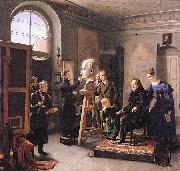
(26 June 1788, Wildenfels, Kursachsen - 4 March 1868, Munich), born Vogel, was a German painter.
Son of the child and portrait painter Christian Leberecht Vogel, Vogel was trained early in life by his father. From 1804 he visited the Kunstakademie in Dresden, where he copied many paintings in the Gemäldegalerie and also produced the first of his own portraits.
In 1807 he replied to an invitation from Baron von Löwenstern, whose children he had taught in Dresden, to come to Dorpat in Livland. In 1808 he moved to Saint Petersburg, where he set up a studio in the princely and successfully worked producing portraits of nobles and diplomats.
In 1812 Vogel was finally rich enough to make a long-desired grand tour to Italy, stopping off at Berlin and Dresden on the way, where he painted his parents and Franz Pettrich. From 1813 to 1820 he lived in Rome, where many German artists were active at that time. He tried to run a middle course between the classicising and romanticising schools then prevailing there, with a style of his own closely drawing on that of Raphael Mengs. In Italy he copied a large number of paintings and wall paintings by the old masters. On later journeys he further augmented his collection of copies and in 1860 published a catalogue of them.
Besides religious paintings, landscapes and anatomical studies, Vogel also produced portraits in Rome, of subjects such as Bertel Thorvaldsen, Lucien Bonaparte and - on behalf of the king of Saxony - Pope Pius VII. Vogel much enjoyed Rome, as Ringseis illustrates by this story - in 1818 he received a gift of a bottle of 1634 Rheinwein wine (given by crown prince Louis I of Bavaria in thanks for the decoration of a festal hall) by unanimous resolution of his colleagues
|
|
 |
carl curman
|
|
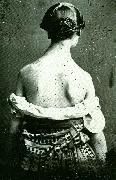
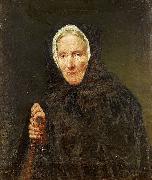
född 8 mars 1833, död 1913, var en svensk vetenskapsman, läkare och professor, som även är känd för de många fotografier |
|
 |
Carl d Unker
|
|
(3 February 1828 - 23 June 1866)was a Swedish artist. He was mostly known as a socially oriented genre painter whose works were contemporary subjects of his time, like waiting rooms at railway stations, and scenes from pawnshops for example.
D'Unkers father was a Norwegian military, his mother Swedish. He began his career as a military and had served at the Svea Life Guards for a short time, when he in 1848 volunteered in the First Schleswig War 1848-1849. Shortly after his return to Sweden he abandoned his military path and went to the arts. He moved to Desseldorf to study painting, there he got married to a wealthy Russian woman and could live a carefree life financially. He became a very popular artist on the continent. From 1861 he suffered from sickness in his right arm so he had to paint with his left arm. He made a brief visit to Sweden in 1865, and was appointed professor by Swedish king Charles XV. The following year he died. |
|
|
|
|