|
|
|
|
|
|
 |
Abraham Storck
|
|
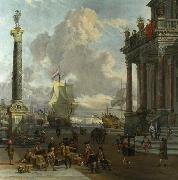
Abraham Storck (or Sturckenburch) (bapt. April 17, 1644 - buried April 8, 1708), was a Dutch landscape and maritime painter of the Baroque era.
Storck was born and died in Amsterdam, and came from a family of painters of the same name. He had a painter's studio in Amsterdam producing naval and harbor scenes as well as landscape paintings. He was influenced by the two Willem van de Veldes (the elder and the younger) and by Jan Abrahamsz Beerstraaten. |
|
|
|
 |
Adolf Schreyer
|
|
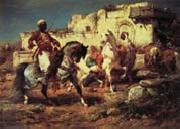
German Academic Painter, 1828-1899,German painter, was born at Frankfurt-am-Main. He studied art first at the Städel Institute in his native town, and then at Stuttgart and Munich. He painted many of his favourite subjects in his travels in the East. He first accompanied Prince Thurn and Taxis through Hungary, Wallachia, Russia and Turkey; then, in 1854, he followed the Austrian army across the Wallachian frontier. In 1856 he went to Egypt and Syria, and in 1861 to Algiers. In 1862 he settled in Paris, but returned to Germany in 1870; and settled at Cronberg near Frankfurt, where he died. Arab Horsemen by Schreyer.Schreyer was, and is still, especially esteemed as a painter of horses, of peasant life in Wallachia and Moldavia, and of battle incidents. His work is remarkable for its excellent equine draughtsmanship, and for the artist's power of observation and forceful statement; and has found particular favour among French and American collectors. Of his battle-pictures there are two at the Schwerin Gallery, and others in the collection of Count Mensdorff-Pouilly and in the Raven Gallery, Berlin. His painting of a Charge of Artillery of Imperial Guard was formerly at the Luxembourg Museum. The Metropolitan Museum, New York owns three of Schreyer's oriental paintings: Abandoned, Arabs on the March and Arabs making a detour; and many of his best pictures are in the Rockefeller family, Vanderbilt family, John Jacob Astor, William Backhouse Astor, Sr., August Belmont, and William Walters collections. |
|
 |
Adolf Seel
|
|
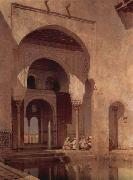
(1 March 1829-14 February 1907) was a German painter. He enjoyed training at the Dseldorf Academy of Arts.
Seel visited the academy in Dseldorf in 1844-50, where he trained under Wilhelm Sohn. He then continued to train one year in Paris, spent 1864 and 1865 in Italy, 1870 and 1871 Spain, Portugal and the north coast of Africa as well as 1873 and 1874 the Orient, where he developed his preference for the architecture painting found rich food. Its pieces of architecture, particularly the Arab and Moorish buildings, are usually provided just as beautiful landscapes painted with a masterful perspective, lighting and coloring.
|
|
 |
Adolf Steel
|
|
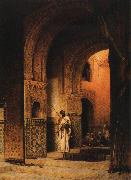
German, 1829 - 1907
German and lived in Germany.
Most of his works are about arab people and arabic street and city. There are a lot of oil paintings which are collected by museums in Europe. |
|
 |
Adriaen van der Spelt
|
|
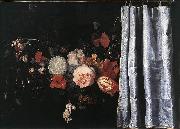
Adriaen van der Spelt (ca. 1630, Leiden - 1673, Gouda), was a Dutch Golden Age flower painter.
According to Houbraken, whose comments were based on the Gouda stories by Ignatius Walvis, he was an excellent flower painter born in Leiden, but his parentage was from Gouda. He spent many years at the court of Brandenburg working for Frederick William I, Elector of Brandenburg, but moved to Gouda to marry a third time with a nasty wife from Groningen who drove him to his grave.
According to the RKD he was a flower painter who spent the years 1664-1670 at the court of Brandenburg. |
|
 |
Adrian Scott Stokes
|
|
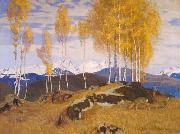
RA (1854-1935) was an English landscape painter. Born in Southport, Lancashire, he became a cotton broker in Liverpool, where his artistic talent was noticed by John Herbert RA, who advised him to submit his drawings to the Royal Academy. He entered the Royal Academy Schools in 1872 and exhibited at the Academy from 1876. In that year went to France where he lived for 10 years, settling back in England in 1886, at Carbis Bay and joining the artists' colony at St Ives.
Adrian Stokes was a landscape painter, concerned most with atmospheric effects, and later with decorative landscapes. He was the author of 'Landscape Painting' (1925). He became ARA in 1909 and RA in 1919, won medals at the Paris Exhibition and Chicago World Fair (1889), became first President of the St Ives Society of Arts (1890) and Vice President of the Royal Watercolour Society (1932).
He married Marianne Preindlesberger of Graz, Austria, in 1884, while living in France. She became a well known artist under her married name of Marianne Stokes. An obituary of Adrian Stokes was published in The Times Monday 2 December 1935
|
|
|
|
 |
Albert Goodwin,RWS
|
|
1845-1932
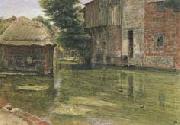
English painter. During the early 1860s Goodwin studied with Arthur Hughes and Ford Madox Brown, who predicted that his pupil would become 'one of the greatest landscape painters of the age'. Hughes and Brown impressed on Goodwin the Pre-Raphaelite principles of high finish, vivid colour and working directly from nature that inform his early landscape style |
|
|
|
 |
Alexandre Seon
|
|
French Symbolist Painter, 1855-1917
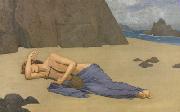
was a French Symbolist artist, illustrator and decorator. Seon studied at the Beaux-Arts of Lyon and Paris, becoming a student of Puvis de Chavannes in 1891, with whom he later collaborated. He was closely associated with Josephin Peladan and his Salon de la Rose-Croix, and designed the frontispiece for Peladan's 1891 novel l'Androgyne |
|
 |
Alexei Savrasov
|
|
Russian Painter, 1830-1897
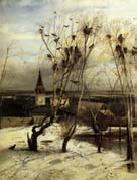
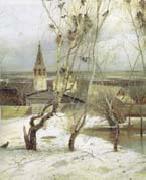
was a Russian landscape painter and creator of the lyrical landscape style. Savrasov was born into the family of a merchant. He began to draw early and in 1838 he enrolled as a student of professor Rabus at the Moscow School of Painting, Sculpture and Architecture (graduated in 1850), and immediately began to specialize in landscape painting. In 1852, he traveled to Ukraine. Then, in 1854 by the invitation of the Grand Duchess Maria Nikolayevna, President of the Imperial Academy of Arts, he moved to the neighborhood of St. Petersburg. In 1857, Savrasov became a teacher at the Moscow School of painting, sculpturing and architecture. His best disciples, Isaac Levitan and Konstantin Korovin, remembered their teacher with admiration and gratitude. The Rooks Have Come Back was painted by Savrasov near Ipatiev Monastery in Kostroma.In 1857, he married Sophia Karlovna Hertz, sister of art historian K. Hertz. In their home they entertained artistic people and collectors including Pavel Tretyakov. Savrasov became especially close with Vasily Perov. Perov helped him paint the figures of the boat trackers in Savrasov's Volga near Yuryevets, Savrasov painted landscapes for Perov's Bird catcher and Hunters on Bivouac. In the 1860s, he traveled to England to see the International Exhibition, and to Switzerland. In one of his letters he wrote that no academies in the world could so advance an artist as the present world exhibition. The painters who influenced him most were British painter John Constable and Swiss painter Alexandre Calame. The Rooks Have Come Back (1871) is considered by many critics to be the high point in Savrasoves artistic career. Using a common, even trivial, episode of birds returning home, and an extremely simple landscape, Savrasov emotionally showed the transition of nature from winter to spring. It was a new type of lyrical landscape painting, called later by critics the mood landscape. The painting brought him fame. In 1870, he became a member of the Peredvizhniki group, breaking with government-sponsored academic art. In 1871, |
|
 |
Alexej Kondratjewitsch Sawrassow
|
|
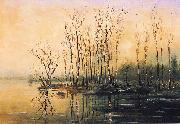
Alexei Kondratyevich Savrasov (Russian) (May 24, 1830 - October 8, 1897) was a Russian landscape painter and creator of the lyrical landscape style.
Savrasov was born into the family of a merchant. He began to draw early and in 1838 he enrolled as a student of professor Rabus at the Moscow School of Painting, Sculpture and Architecture (graduated in 1850), and immediately began to specialize in landscape painting.
In 1852, he traveled to Ukraine. Then, in 1854 by the invitation of the Grand Duchess Maria Nikolayevna, President of the Imperial Academy of Arts, he moved to the neighborhood of St. Petersburg. In 1857, Savrasov became a teacher at the Moscow School of painting, sculpturing and architecture. His best disciples, Isaac Levitan and Konstantin Korovin, remembered their teacher with admiration and gratitude.
|
|
 |
Alexis Simon Belle
|
|
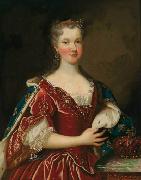
(12 January 1674 - 21 November 1734) was a French portrait painter, known for his portraits of the French and Jacobite nobility.
Belle was born in Paris, the second child and only son of Jean-Baptiste Belle (born before 1642, died 1703), also a painter, and of Anne his wife (died 1705).
Belle's birth and baptism are recorded in the parish register of the church of Saint-Sulpice, Paris, and quoted in Eugene Piot's Le Cabinet de l'amateur for the years 1861 and 1862
|
|
|
|
 |
Alfred Seifert
|
|
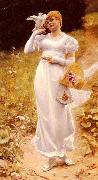
(September 6, 1850 Praskolesy, Bohemia - February 6, 1901, Munich, Germany) was a Czech-German painter, famous for his female portraits.
He was born in Praskolesy (present-day Czech Republic) but within a few months, his family moved to nearby Hořovice.
As a child, he fell seriously ill, could not walk for four years and spent two years in an orthopedic institution. Instead of playing, he started to draw pictures and his artistic talent soon started to emerge. His first teachers were Karel Werbs, inspector of Estates Gallery at Prague Castle, and Alois Kirnig, landscape painter. |
|
 |
Alfred Sisley
|
|
French
1839-1899
Alfred Sisley Galleries
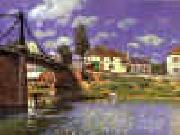
Alfred Sisley (October 30, 1839 ?C January 29, 1899) was an English Impressionist landscape painter who was born and spent most of his life in France. Sisley is recognized as perhaps the most consistent of the Impressionists, never deviating into figure painting or finding that the movement did not fulfill his artistic needs.
Sisley was born in Paris to affluent English parents; William Sisley was in the silk business, and his mother Felicia Sell was a cultivated music connoisseur. At the age of 18, Sisley was sent to London to study for a career in business, but he abandoned it after four years and returned to Paris. Beginning in 1862 he studied at the atelier of Swiss artist Marc-Charles-Gabriel Gleyre, where he became acquainted with Fr??d??ric Bazille, Claude Monet, and Pierre-Auguste Renoir. Together they would paint landscapes en plein air (in the open air) in order to realistically capture the transient effects of sunlight. This approach, innovative at the time, resulted in paintings more colorful and more broadly painted than the public was accustomed to seeing. Consequently, Sisley and his friends initially had few opportunities to exhibit or sell their work. Unlike some of his fellow students who suffered financial hardships, Sisley received an allowance from his father??until 1870, after which time he became increasingly poor. Sisley's student works are lost. His earliest known work, Lane near a Small Town is believed to have been painted around 1864. His first landscape paintings are sombre, coloured with dark browns, greens, and pale blues. They were often executed at Marly and Saint-Cloud. |
|
 |
Alfred Stevens
|
|
1823-1906
Alfred Stevens Galleries
Flemish
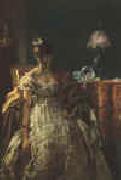
Alfred Emile Stevens (May 11, 1823 - August 29, 1906) , Belgian painter, was born in Brussels.
El??gants sur les BoulevardsHis father, an old officer in the service of William I of the Netherlands, was passionately fond of pictures, and readily allowed his son to draw in the studio of François Navez, director of the Brussels Academy.
In 1844 Stevens went to Paris and worked under the instructing of Camille Roqueplan, a friend of his father's; he also attended the classes at the Ecole des Beaux-Arts, where Ingres was then professor. In 1849 he painted at Brussels his first picture, A Soldier in Trouble, and in the same year went back to Paris, where he definitely settled, and exhibited in the Salons. He then painted Ash-Wednesday Morning, Burghers and Country People finding at Daybreak the Body of a Murdered Gentleman, An Artist in Despair, and The Love of Gold.
Allegory of the Night
MSK, Oostende, BelgiumIn 1855 he exhibited at the Antwerp Salon a little picture called At Home, which showed the painter's bent towards depicting ladies of fashion. At the Great Exhibition in Paris, 1855, his contributions were remarkable, but in 1857 he returned to graceful female subjects, and his path thenceforth was clear before him. At the Great Exhibition of 1867 he was seen in a brilliant variety of works in the manner he had made his own, sending eighteen exquisite paintings; among them were the Lady in Pink (in the Brussels Gallery), Consolation, Every Good Fortune, Miss Fauvette, Ophelia, and India in Paris.
At the Paris International Exhibitions of 1878 and 1889, and at the Historical Exhibition of Belgian Art, Brussels, 1880, he exhibited The Four Seasons (in the Palace at Brussels), The Parisian Sphinx, The Japanese Mask, The Japanese Robe, and The Lady-bird (Brussels Gallery).
"Alfred Stevens is one of the race of great painters," wrote Camille Lemonnier, "and like them he takes immense pains with the execution of his work." The example of his finished technique was salutary, not merely to his brethren in Belgium, but to many foreign painters who received encouragement from the study of his method. The brother of Alfred Stevens, Joseph Stevens, was a great painter of dogs and dog life. See J. du Jardin, L'Art flamand; Camille Lemonnier, Histoire des beaux arts en Belgique.
|
|
 |
Alfred Stieglitz
|
|
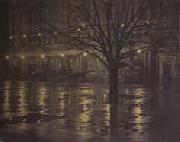
American Photographer, 1864-1946..S. photographer and exhibitor of modern art. He was taken to Europe by his wealthy family to further his education in 1881. In 1883 he abandoned engineering studies in Berlin for a photographic career. Returning to the U.S. in 1890, he made the first successful photographs in snow, in rain, and at night. In 1902 he founded the Photo-Secession group to establish photography as an art. His own best photographs are perhaps two series (1917 C 27), one of portraits of his wife, Georgia O'Keeffe, and the other of cloud shapes corresponding to emotional experiences. His photographs were the first to be exhibited in major U.S. museums. |
|
|
|
|
|
|
|
 |
Alois Hans Schram
|
|
Alois Hans Schram
(1864 - 1919)
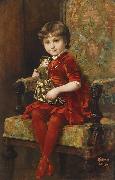
Alois Hans Schram was born in Vienna on August 20th. He was a painter and sculptor of historical subjects, figures, nudes, portraits, scenes with figures, genre scenes, local scenes, interiors with figures, landscapes with figures, urban landscapes, waterscapes and seascapes. |
|
 |
Alonso Sanchez Coello
|
|
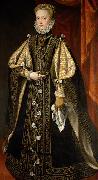
Alonso Sachez Coello (1531/32 -August 8, 1588) was a portrait painter of the Spanish Renaissance and one of the pioneers of the great tradition of Spanish portrait painting.
Alonso Sachez Coello was born in Benifairode les Valls, near Valencia, and spent his childhood there, until the death of his father when he was around ten years old. He was educated in Portugal at his grandfather's home. Coello's years in Portugal and his family name of Portuguese origin led to a long-standing belief that he was in fact Portuguese. His grandfather (after whom he was named) was in the service of King John III of Portugal who sent the young painter to study with Anthonis Mor (also known as Antonio Moro) in Flanders around 1550. He was under the service of Antoine de Granville, bishop of Arras, learning from Mor. While studying in Flanders, Coello also spent time copying some of Titian's works. |
|
|
|
 |
Andrea del Sarto
|
|
b.July 16, 1486, Florence
d.Sept. 28, 1530, Florence
Italian Andrea del Sarto Galleries
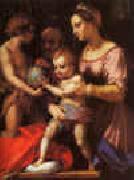
Andrea del Sarto (1486 ?C 1531) was an Italian painter from Florence, whose career flourished during the High Renaissance and early-Mannerism. Though highly regarded by his contemporaries as an artist "senza errori" (i.e., faultless), he is overshadowed now by equally talented contemporaries like Raphael.
Andrea fell in love with Lucrezia (del Fede), wife of a hatter named Carlo, of Recanati; the hatter dying opportunely, Andrea married her on 26 December 1512. She has come down to us in many a picture of her lover-husband, who constantly painted her as a Madonna and otherwise; even in painting other women he made them resemble Lucrezia. She was less gently handled by Giorgio Vasari, a pupil of Andrea, who describes her as faithless, jealous, and vixenish with the apprentices; her offstage character permeates Robert Browning's poem-monologue "Andrea del Sarto called the 'faultless painter'" (1855) .
He dwelt in Florence throughout the memorable siege of 1529, which was soon followed by an infectious pestilence. He caught the malady, struggled against it with little or no tending from his wife, who held aloof, and he died, no one knowing much about it at the moment, on 22 January 1531, at the comparatively early age of forty-three. He was buried unceremoniously in the church of the Servites. His wife survived her husband by forty years.
A number of paintings are considered to be self-portraits. One is in the National Gallery, London, an admirable half-figure, purchased in 1862. Another is at Alnwick Castle, a young man about twenty years, with his elbow on a table. Another youthful portrait is in the Uffizi Gallery, and the Pitti Palace contains more than one. |
|
 |
Andrea Sacchi
|
|
1559-1661
Italian
Andrea Sacchi Gallery
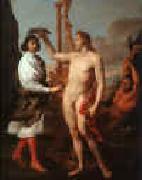
As a young man, Sacchi had worked under Cortona in Castel Fusano (1627-1629). But in a set of public debates later developed in the Roman Artist's Guild, Accademia di San Luca, he strongly criticized Cortona's exuberance. In particular, Sacchi advocated that since a unique, individual expression needs to be assigned to each figure in a composition, a painting should not consist of more than about ten figures. In a crowded composition, the figures would be deprived of individuality, and thus cloud the particular meaning of the piece. In some ways this is a reaction against the zealous excess of crowds in paintings by men such as Zuccari of the prior generation, and by Cortona among his contemporaries. Simplicity and unity were essential to Sacchi. Cortona argued that large paintings were more like an epic, that could avail themselves of multiple subplots. The encrustation of a painting with excess decorative details, including melees of crowds, would represent "wall-paper" art rather than focused narrative. Among the partisan's of Sacchi's argument for simplicity and focus were his friends, the sculptor Algardi and painter Poussin.
The controversy was however less pitched than some suggest, and also involved the dissatisfaction that Sacchi and Albani, among others, shared regarding the artistic depiction of low or genre subjects and themes, such as preferred by the Bamboccianti and even the Caravaggisti. They felt that high art should focus on exalted themes- biblical, mythologic, or from classic history.
Sacchi, who worked almost always in Rome, left few pictures visible in private galleries. He had a flourishing school: Poussin and Carlo Maratta were younger collaborators or pupils. In Maratta's large studio, Sacchi's preference for grand manner style would find pre-eminence among Roman circles for decades to follow. But many others worked under him or his influence including Luigi Garzi, Francesco Lauri, Andrea Camassei and Giacinto Gimignani. Sacchi's own illegitimate son Giuseppe, died young after giving very high hopes.
Sacchi died at Nettuno in 1661. |
|
 |
Andrea Solario
|
|
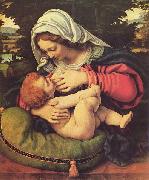
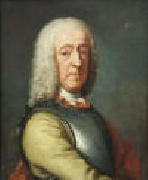
Andrea Solari (also Solario) (1460 in Milano - 1524) was an Italian Renaissance painter. He was initially named Andre del Gobbo, but more confusingly as Andrea del Bartolo a name shared with two other Italian painters, the 14th Century Siennese Andrea di Bartolo, and the 15th Century Florentine Andrea di Bartolo. |
|
 |
Andrea Soldi
|
|
Italian
C1703-1771
Italian painter. George Vertue, the only source for Soldi's earliest years, described him in 1738 as a Florentine aged 'about thirty-five or rather more' who had been in England 'about two years'. He had previously been in the Middle East, where he painted some British merchants of the Levant Company who had advised him to go to London. Two three-quarter-length portraits called Thomas Sheppard (1733 and 1735-6; ex-art market, London, 1917 and 1924, see Ingamells, 1974) belong to this period. In London Soldi enjoyed considerable success in the period between 1738 and 1744; Vertue reported that he began 'above thirty portraits' between April and August 1738. He was extensively patronized by the 2nd and 3rd Dukes of Manchester (eight portraits, sold Kimbolton Castle, Cambs, 18 July 1949), the 3rd Duke of Beaufort (four portraits at Badminton House, Glos) and the 4th Viscount Fauconberg (eight portraits at Newburgh Priory, N. Yorks). The seated three-quarter-length of Isabella, Duchess of Manchester, as Diana (1738; London, Colnaghi's, 1986) and the informal full-length of Lord Fauconberg (c. 1739; Newburgh Priory, N. Yorks) exemplify his lively handling, strong colour and theatrical, Italianate imagination. In a less extravagant vein, the Duncombe Family (1741; priv. col., see Ingamells, 1974), a conversation piece of some charm, and the Self-portrait (1743; York, C.A.G.) suggest a versatile talent. Soldi's bravura contrasted with contemporary English portrait practice, then wavering between the sober manner of Kneller and a playful Rococo, and his attraction for Italianate Englishmen was obvious. He was rivalled only by Jean-Baptiste van Loo, who was in London between 1737 and 1742; both artists painted the dealer Owen McSwiny and the poet Colley Cibber about 1738. He far outclassed his Italian rivals, the Cavaliere Rusca (1696-1769), who worked in London from 1738 to 1739, and Andrea Casali, who was in London from 1741 to 1766. |
|
 |
Andreas Schelfhout
|
|
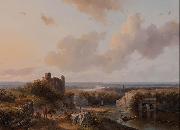
(February 16, 1787, The Hague - April 19, 1870, The Hague) was a Dutch painter, etcher and lithographer, known for his landscape paintings.
He belongs to the Romantic movement. His Dutch winter scenes and frozen canals with skaters were already famous during his lifetime. He became one of the most influential Dutch landscape artists of his century.
He started as a house painter in the framing business of his father. He already started painting pictures in his spare time. After a well-received first exhibition in The Hague, his father sent him to receive proper training to Joannes Breckenheimer (1772-1856), a stage designer, in The Hague. He learned not only the technical aspects of painting, but also made detailed studies of the 17th-century Dutch landscape artists Meindert Hobbema en Jacob van Ruisdael.
In 1815 he started his own workshop. Through his technical excellence and sense of composition and his use of naturalistic colours, he soon became famous also outside The Hague. In 1819 he was awarded the Gold Medal at the exhibition in Antwerp. In 1818 he became a member of the Royal Academy for Visual Arts of Amsterdam. He reputation continued to grow and in1822 he was given the rank of Fourth Class Correspondent of the Royal Dutch Institute. From then on, one exhibition followed after another.
Initially he painted mainly summer scenes, beach scenes, and animal paintings. But as his initial winter scenes even had more success, he began to include them in his exhibitions. He was mainly a studio artist, relying on his sketches done en plein air. His sketchbook Liber Veritatis (Book of Truth) shows that he made about twenty paintings a year, among them a few foreign views. This indicated that he travelled abroad around 1825. In later years he visited France in 1833, England in 1835 (especially to study the works of Constable) and Germany.
He provided training to several painters who would become famous in their own right : Johan Hendrik Weissenbruch, Johan Jongkind (one of the forerunners of the Impressionists), Charles Leickert, Jan Willem van Borselen, Nicholas Roosenboom, Willem Troost, the American Hudson River School Painter Louis Remy Mignot and his son-in-law Wijnand Nuyen.
At the end of his career he put together a series of eighty landscape drawings, mainly recordings of previous paintings and watercolours. They were drawn in chalk and lightly coloured.
His death marked the end of the Romantic period in Holland. He is considered a precursor of the Hague School
|
|
 |
Andreas Stech
|
|
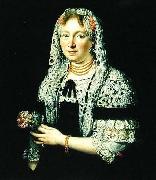
painted Portrait of a Patrician Lady from Gdansk in 1685 |
|
 |
ANGUISSOLA Sofonisba
|
|
Italian Mannerist Painter, 1532-1625
The best known of the sisters, she was trained, with Elena, by Campi and Gatti. Most of Vasari's account of his visit to the Anguissola family is devoted to Sofonisba, about whom he wrote: 'Anguissola has shown greater application and better grace than any other woman of our age in her endeavours at drawing; she has thus succeeded not only in drawing, colouring and painting from nature, and copying excellently from others, but by herself has created rare and very beautiful paintings'. Sofonisba's privileged background was unusual among woman artists of the 16th century, most of whom, like Lavinia Fontana (see FONTANA (ii),(2)), FEDE GALIZIA and Barbara Longhi (see LONGHI (i), (3)), were daughters of painters. Her social class did not, however, enable her to transcend the constraints of her sex. Without the possibility of studying anatomy, or drawing from life, she could not undertake the complex multi-figure compositions required for large-scale religious or history paintings. She turned instead to the models accessible to her, exploring a new type of portraiture with sitters in informal domestic settings. The influence of Campi, whose reputation was based on portraiture, is evident in her early works, such as the Self-portrait (Florence, Uffizi). Her work was allied to the worldly tradition of Cremona, much influenced by the art of Parma and Mantua, in which even religious works were imbued with extreme delicacy and charm. From Gatti she seems to have absorbed elements reminiscent of Correggio, beginning a trend that became marked in Cremonese painting of the late 16th century. This new direction is reflected in Lucia, Minerva and Europa Anguissola Playing Chess (1555; Poznan, N. Mus.) in which portraiture merges into a quasi-genre scene, a characteristic derived from Brescian models. |
|
 |
anguissola sofonisba
|
|
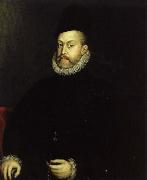
The best known of the sisters, she was trained, with Elena, by Campi and Gatti. Most of Vasari's account of his visit to the Anguissola family is devoted to Sofonisba, about whom he wrote: 'Anguissola has shown greater application and better grace than any other woman of our age in her endeavours at drawing; she has thus succeeded not only in drawing, colouring and painting from nature, and copying excellently from others, but by herself has created rare and very beautiful paintings'. Sofonisba's privileged background was unusual among woman artists of the 16th century, most of whom, like Lavinia Fontana (see FONTANA (ii),(2)), FEDE GALIZIA and Barbara Longhi (see LONGHI (i), (3)), were daughters of painters. Her social class did not, however, enable her to transcend the constraints of her sex. Without the possibility of studying anatomy, or drawing from life, she could not undertake the complex multi-figure compositions required for large-scale religious or history paintings. She turned instead to the models accessible to her, exploring a new type of portraiture with sitters in informal domestic settings. The influence of Campi, whose reputation was based on portraiture, is evident in her early works, such as the Self-portrait (Florence, Uffizi). Her work was allied to the worldly tradition of Cremona, much influenced by the art of Parma and Mantua, in which even religious works were imbued with extreme delicacy and charm. From Gatti she seems to have absorbed elements reminiscent of Correggio, beginning a trend that became marked in Cremonese painting of the late 16th century. This new direction is reflected in Lucia, Minerva and Europa Anguissola Playing Chess (1555; Poznan, N. Mus.) in which portraiture merges into a quasi-genre scene, a characteristic derived from Brescian models.
|
|
|
|
|
|
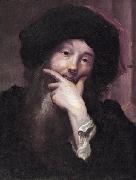 |
Anthoni Schoonjans
|
|
(1655 - 13 August 1726) was a Flemish painter.
He was born in Antwerp and became a pupil of Erasmus Quellinus II and his son Jan-Erasmus Quellinus. He travelled to Rome and like his teachers had done before him, joined the Bentvueghels with the nickname "Parrhasius" in 1674. In Rome he lived with Charles de Vogelaer in the via Margutta and later he lived from 1688-89 in the Corso, near the via di Ripetta. In 1695 he became court painter in Vienna, where he later died. During the course of his lengthy career he also worked in Antwerp, Riems, Lyon, Amsterdam, the Hague, Brno, Dusseldorf, Copenhagen, and Berlin.He is known for portraits and historical allegories, and was the teacher of Georg Gsell. |
|
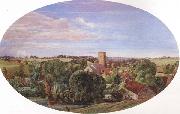 |
Anthony Frederick Augustus Sandys
|
|
1829-1904
English painter, illustrator and draughtsman. He was the son of Anthony Sands (1804-83), a minor local artist. He began his artistic education with his father and attended the Norwich School of Design from 1846. His precocious talent was recognized by the award of silver medals by the Society of Arts in 1846 and 1847. He moved to London in 1851, when he first exhibited at the Royal Academy, but he continued to spend time at Norwich until the death of his parents in 1883. After publishing in 1857 A Nightmare, a gentle caricature of John Ruskin and his Pre-Raphaelite prot?g?s William Holman Hunt, John Everett Millais and Dante Gabriel Rossetti and based on Millais's Sir Isumbras at the Ford (Port Sunlight, Lady Lever A.G.), he met Rossetti and became a member of his circle. |
|
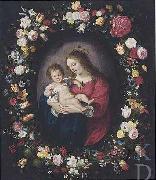 |
Antoine Sallaert
|
|
(1585-1650) was a Flemish Baroque painter.
According to Houbraken his work survived in Brussels, where he lived and died. He was sorry he could not find more data on this artist. According to the RKD he was registered in the Brussels Guild of Saint Luke as a master in 1613 and used the monograms ASall f and AS entwined. |
|
|
|
|
|
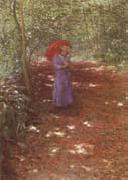 |
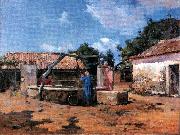
Antonin Slavicek
|
|
1870 - 1918
(1870?C1910) was a renowned Czech painter. He was a part of the Czech impressionist movement. One of his most famous works is Garden Wall, which hangs in the National Gallery in Prague.
|
|
 |
Antonio Carvalho de Silva Porto
|
|
(Porto, 11 November 1850 - Porto, 11 June 1893) was a Portuguese naturalist painter.
Born in Porto, he studied there under João Antenio Correia and T. Furtado, then continued his studies in Paris and Rome.
While in Paris he exhibited his work in the Salon and in the World´s Fair of 1878. In Paris, he studied with his friend João Marques de Oliveira, where they were pupils of Adolphe Yvon and Alexandre Cabanel. They became followers of the naturalist Barbizon School, and brought the new school of painting to Portugal, when they returned in 1879.
Silva Porto become one of the most acclaimed naturalist painters of his generation, showing the heritage of Jean-Baptiste Camille Corot and Charles-François Daubigny. Secondary effects from impressionism can sometimes be found in his paintings.
|
|
|
|
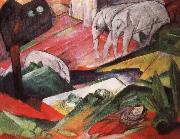 |
arnold schoenberg
|
|
Period: Modern (1910-1949)
Country: Austria/USA
Born: September 13, 1874 in Vienna, Austria
Died: July 13, 1951 in Los Angeles, CA
Genres: Band Music, Chamber Music, Choral Music, Concerto, Keyboard Music, Miscellaneous Music, Opera, Orchestral Music, Vocal Music
|
|
|
|
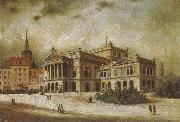 |
arthur o shaughnessy
|
|
1844 C 81, English poet and naturalist. He was a member of the zoological department of the British Museum. He wrote four volumes of poetrye Epic of Women (1870), Lays of France (1872), Music and Moonlight (1874), and Songs of a Worker (1881)??which all reveal the influence of D. G. Rossetti. One ode, beginning, We are the music-makers, is his best-known poem. |
|
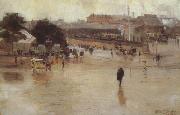 |
Arthur streeton
|
|
1867 - 1943
Australian painter. He moved to Melbourne with his family when he was seven. In 1882 he enrolled as a student of drawing at the evening classes of the National Gallery School of Design and briefly in the School of Painting, but he had no sustained formal instruction in painting. At the same time he began making watercolour sketches of Melbourne, and by 1886 his skill led to an apprenticeship as a lithographer to George Troedel and Co. of Collins Street. The most important early influence on Streeton was Tom Roberts, who had returned to Melbourne from Europe in 1885. With Frederick McCubbin, Streeton and Roberts painted en plein air at a temporary camp at Box Hill, forming what became known as the HEIDELBERG SCHOOL. A little later Streeton established the first permanent artists' camp at Eaglemont, north-west of Melbourne, overlooking the Yarra Valley, where he painted some of his most memorable works. 'Still glides the stream and shall forever glide' |
|
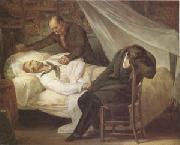 |
Ary Scheffer
|
|
Dordrecht 1795-Argenteuil 1858
Dutch painter, sculptor and lithographer, active in France. He became a French citizen in 1850. He received his earliest training in the studio of his parents, Johann-Bernhard Scheffer (1764-1809) and Cornelia Scheffer (1769-1839), who were both artists, as was his brother Henri Scheffer (1798-1862). He then attended the Amsterdam Teeken-Academie (1806-9). At the first Exhibition of Living Masters in Amsterdam in 1808 he showed Hannibal Swearing to Avenge the Death of his Brother Hasdrubal |
|
|