|
|
|
|
|
|
 |
Abbey, Edwin Austin
|
|
American Golden Age Illustrator and Muralist, 1852-1911
American painter and illustrator, active in England. He began his artistic training in 1866, studying drawing with the Philadelphia portrait and landscape painter Isaac L. Williams (1817-95). In 1868 he attended evening classes in drawing at the Pennsylvania Academy of the Fine Arts under Christian Schussele (1824-79). In the same year Abbey began to work as an illustrator for the Philadelphia publishers Van Ingen & Snyder. In 1870 Harper's Weekly published the Puritans' First Thanksgiving, and in 1871 Abbey moved to New York to join the staff of Harper & Brothers, thus inaugurating his most important professional relationship. Throughout the 1870s Abbey's reputation grew, both for his detailed exhibition watercolours and for his elegant line drawings, which, translated to wood-engravings in numerous periodicals, illustrated both factual and fictional events of the past and present. The influences on him were mainly English, in particular the works of the Pre-Raphaelite Brotherhood and illustrations in the English press, which he studied avidly. The success of his illustrations to some of Robert Herrick's poems, such as Corinna's Going A-Maying in Harper's New Monthly Magazine (May 1874), prompted Harper & Brothers in 1878 to send Abbey to England to do a complete series of drawings for an illustrated gift-book, Selections from the Poetry of Robert Herrick (New York, 1882). |
|
|
|
 |
Achille-Etna Michallon
|
|
Paris 1796-1822
was a French painter. Michallon was the son of the sculptor Claude Michallon. He studied under Jacques-Louis David and Pierre-Henri de Valenciennes. In 1817, Michallon won the inaugural Prix de Rome for landscape painting. He travelled to Italy in 1818 and remained there for over two years. This trip had a profound influence on his work. Before he had much time to develop what he had learned however, he died at the age of 26 of pneumonia, a tragedy which cut short the life of a talented and well respected artist who could have gone on to win lasting fame. Though it is often disputed, it is thought that at one time, Corot was his pupil. |
|
 |
Adam Elsheimer
|
|
German Baroque Era Painter, 1578-1610
German painter, printmaker and draughtsman, active in Italy. His small paintings on copper established him after his brief life as the most singular and influential German artist to follow D?rer. Their grand conception in terms of monumental figures and poetic landscape and their meticulous, miniature-like execution were admired by Rubens and came to influence many 17th-century artists, including Rembrandt. |
|
|
|
|
|
|
|
 |
Albert Eckhout
|
|
Groningen, 1610 - 1666,was a Dutch portrait and still life painter. Eckhout was among the first European artists to paint scenes from the New World. In 1636, he traveled to Dutch Brazil, invited by count John Maurice, Prince of Nassau-Siegen. There, he painted portraits of natives, slaves and mulattos. He is also famous for his still lifes of Brazilian fruits and vegetables. The majority of his work is now stored at the National Museum of Denmark in Copenhagen. In art history, he is taken to be part of Baroque. |
|
 |
Albert Edelfelt
|
|
1854-1905
Finnish
Albert Edelfelt Location
Finnish painter, illustrator and etcher. He was Finland leading artist in the late 19th century, introducing French influences into Finnish art but also helping to gain a broader international interest in his country culture. He was not a great innovator, however, and although his reputation in Finland remained firm, international recognition dwindled after his death until the renewal of interest in realism that took place in the late 20th century. |
|
|
|
 |
Albin Egger Lienz
|
|
Albin Egger-Lienz (29 January 1868 - 4 November 1926) was an Austrian painter.
He was born in Dölsach-Stribach near Lienz, in what was the county of Tyrol. As an artist, he had a special preference for rustic genre and historical paintings; under the influence of Ferdinand Hodler, Egger-Lienz abstracted his formal language into monumental expressiveness.
He trained first under his father (a church painter), later he studied at the Academy in Munich where he was influenced by Franz Defregger and French painter Jean-François Millet. In 1899 he moved to Vienna. During 1911 and 1912 he was professor at the Weimar School of Fine Arts and he served as war painter during World War I. In 1918, he turned down a professorship at the Vienna Academy and settled in South Tyrol. Egger-Lienz died on 4 November 1926 in St. Justina-Rentsch, Bolzano, Italy. |
|
|
|
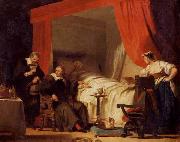 |
Alexandre-Evariste Fragonard
|
|
French Painter, 1780-1850,son of Jean-Honore Fragonard, was a French painter and sculptor in the troubadour style. He received his first training from his father and drew from him his piquant subjects and great facility, perfecting them under David. |
|
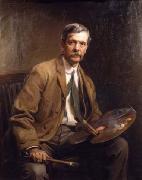 |
Alfred East
|
|
(December 15, 1849 C September 28, 1913) was an English painter.
He was born in Kettering in Northamptonshire and studied at the Glasgow School of Art. His romantic landscapes show the influence of the Barbizon school. His The Art of Landscape Painting in Oil Colour was published in 1906. In April 1888 he had shared an exhibition at the galleries of the Fine Art Society with T.C. Gotch and W. Ayerst Ingram, and was commissioned the following year by Marcus Huish, Managing Director of the Society, to spend six months in Japan to paint the landscape and the people of the country. When the exhibition of 104 paintings from this tour was held at the Fine Art Society in 1890 it was a spectacuar success. He was awarded a Knighthood in 1910 by King Edward VII. His portrait was painted by Philip de Laszlo. On Sunday, 28 September 1913, Alfred East died at his London residence in Belsize Park. |
|
|
|
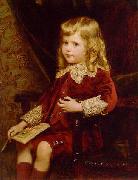 |
Alfred Edward Emslie
|
|
Alfred Edward Emslie (1848 London -1918) was an English genre and portrait painter, and photographer, living at The Studio, 34, Finchley Road, N. W.
He was the son of the engraver, John Emslie, and brother of John Phillipps Emslie, the figure painter. Married to miniature painter Rosalie M. Emslie, they had a daughter, Rosalie Emslie, who became a figure, portrait and landscape painter. Emslie turned increasingly to portraiture later in life. He had a great passion for the Orient, and spent three months exploring Japan. He was a elected an associate of the Royal Society of Painters in Water Colours in 1888 and a member of the Royal Society of Portrait Painters in 1892.
|
|
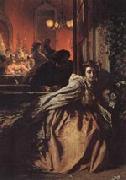 |
Alfred Elmore
|
|
Irish-born British Painter, 1815-1881
was a Victorian history and genre painter. He was born in Cork, Ireland, the son of Dr. John Richard Elmore, a surgeon who retired from the British Army to Clonakilty. His family moved to London, where Elmore studied at the Royal Academy of Arts. His early works were in the troubadour style of Richard Parkes Bonington, but he soon graduated to religious work, notably The Martyrdom of Thomas Becket, commissioned by Daniel O'Connell for Westland Row Church in Dublin. Between 1840 and 1844 Elmore travelled across Europe, visiting Munich, Venice, Bologna, and Florence. Elmore seems to have been associated with The Clique, a group of young artists who saw themselves as followers of Hogarth and David Wilkie. According to his friend William Powell Frith he was member of the group, but since it was most active while he was in continental Europe, his involvement was probably short-lived. Most of Elmore's later works were historical narrative paintings. Religious Controversy and The Novice were implicitly anti-Catholic in character. Other paintings set episodes from Shakespeare, or the history of the French Revolution. They often contained subtle explorations of the process of creation, most importantly his two paintings about technological innovation, The Invention of the Stocking Loom (1847, Nottingham Castle Museum) and The Invention of the Combing Machine (1862, Cartwright Hall, Bradford). Both portray the process of industrialisation by depicting picturesque pre-industrial handicrafts. The inventor is supposed to be pondering these manual skills while he forms in his mind a mechanism to replace them. Elmore's best-known work is On the Brink (1865; Fitzwilliam Museum, Cambridge), a moral genre painting depicting a young woman who has lost her money gambling, and is 'on the brink' of responding to the blandishments of a seducer, who is depicted as a satan-like figure, |
|
 |
allart van everdingen
|
|
Allaert van Everdingen (bapt. 18 June 1621 Alkmaar - buried 8 November 1675, Amsterdam), was a Dutch Golden Age painter and printmaker in etching and mezzotint.
Van Everdingen was the son of a government clerk at Alkmaar. He and his older brothers, the painters Jan and Caesar van Everdingen, according to Arnold Houbraken, were taught by Roelandt Savery at Utrecht. Allaert moved in 1645 to Haarlem, where he studied under Pieter de Molijn, and finally settled about 1657 at Amsterdam, where he died in 1675. |
|
|
|
|
|
 |
Andries van Eertvelt
|
|
1590-1652
Flemish
Andries van Eertvelt Location
Flemish painter. He enrolled as a member of Antwerp Guild of St Luke in 1609. In 1615 he married Catherine Vlieger (d 1627), after whose death he went to Genoa, where he worked for Cornelis de Wael. By c. 1630 he was back in Antwerp, where he had his portrait painted by Anthony van Dyck (1632; Augsburg, Schaezlerpal.). In 1633 Eertvelt married Elisabeth Boots, probably a daughter of the Antwerp painter Jan Boots (b before 1620). Eertvelt is regarded as the first Flemish marine painter. Over the years his palette and style changed. His first paintings, mostly of ships in storms (e.g. Sea Battle in a Storm; Schwerin, Staatl. Mus.), were painted in greenish-black and brown tones, often using white to highlight the rigging against the dark sea. After his tour of Italy he favoured views of southern harbours, with calm seas painted in soft tones (e.g. Spanish Ships Leaving a Port; Vienna, Ksthist. Mus.). In his day Eertvelt was a man of distinction whose artistic qualities were praised by the poet Cornelis de Bie and whose marine paintings were appreciated abroad, some being exported as far as Seville and Lisbon. His pupils included Gaspard van Eyck (1613-73), Hendrik Minderhout (1632-96) and Matthieu van Plattenberg. |
|
 |
Anna Elizabeth Klumpke
|
|
1856-1942
Anna Elizabeth Klumpke (October 28, 1856?C1942) was American portrait and genre painter born in San Francisco, California, United States. She is perhaps best known for her portraits of famous women including Rosa Bonheur and Elizabeth Cady Stanton (1889).
Her father, John Gerald Klumpke, born in England or Germany , was a successful and wealthy realtor in San Francisco. Her mother was Dorothea Mattilda Tolle. Anna was the eldest of eight children, five of whom lived to maturity. Among her siblings were the astronomer Dorothea Klumpke-Roberts, the violinist Julia Klumpke, and the neurologist Augusta D??jerine-Klumpke.
At age three, Anna fell and suffered a fracture of her femur. She fell again at age five and suffered osteomyelitis with purulent knee arthritis. It handicapped her, and her mother took extraordinary means to remeded the problem by taking Anna and three siblings to Berlin for treatment by Dr. Bernhard von Langenbeck.
The treatments lasted 18 months, including thermal baths at Kreuznach, but unfortunately they were not successful, and she would remained hobbled all her life. While in Europe, her mother ensured that all of her children had excellent tutoring.
The time away in Europe placed a strain on the relationship of her parents. When Anna was fifteen, her parents divorced. She and her siblings (now numbering five) moved with their mother to Göttingen, Germany, where they lived for a time with Mattilda's sister, who had married a German national. Anna and her sister Augusta were sent to school at Cannstatt, near Stuttgart. At age seventeen, the family moved to Clarens, near Lake Geneva in Switzerland where she spent two years in boarding school. She studied art at home for the next few years, and in October 1877, moved with her family once more to Paris, where she was later enrolled in the Julian Academy (1883-1884), under the tutelage of Tony Robert-Fleury and Jules Lefebvre. At one point she also studied under Vuillefroy. She presented her first work at the Paris Salon in 1884, while still at the Academy, and she won the grand prize for outstanding student of the year. She showed regularly at the Salon for several more years. |
|
 |
Anna Maria Ehrenstrahl
|
|
1666-1729,as married Wattrang, (1666-1729), was Swedish painter, the first female painter in her country. She was a baroque-artist and painted allegorys, portraits and group portraits in the style of the Baroque. Born as child of the court painter David Klocker Ehrenstrahl and Maria Momma, she was instructed as a student by her father to copy and finish his works and to paint details and other such smaller things to complete the paintings in his studio. She is confirmed as her fathers assistant from ca 1680. Her learning as an artist was therefore not complete, as he never intended her to become an independent artist, just as a form of artistic secretary in his studio, but she was in fact to create paintings herself eventually. In 1688 she married Johan Wattrang, vice president in Svea Hovratt, and painted six portraits of this courts former presidents, which she gave the court signed with her own name (1717). Her way of painting was in the same barocque style as her father; she painted allergorys and portraits of both single people and groups, bot real people and mytholocigal figures in the style of the time. Among them was portraits of king Charles XI of Sweden, Prince Ulrik (in 1685), an allegory over the four seasons (1687) and an allegory of Cupid and Psyche. She painted the four king's under her lifetime, the Princes Gustaf and Fredrik, Ulrika Eleonora of Denmark and Aurora Konigsmarck. |
|
|
|
 |
Antonio Maria Esquivel
|
|
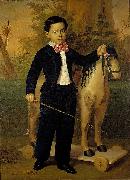
Nacio en Sevilla en 1806. Comenzo los estudios de pintura en la Academia de Bellas Artes de Sevilla. Alli se familiarizo con la tecnica pictorica y el detallismo al estilo de Murillo.
En 1831, se traslado a Madrid, donde concurso en la Academia de San Fernando, siendo nombrado academico de merito. En contacto con el ambiente intectual madrileno de esos anos, participo activamente en la fundacion del Liceo Artistico y Literario en 1837, donde daria clases de Anatomia, asignatura que impartiria tambien mas tarde en la Academia de San Fernando.
En 1839, otra vez en Sevilla, sufrio una enfermedad que le dejo practicamente ciego; el artista, sumido en una profunda depresion, se intento suicidar arrojandose al rio Guadalquivir. Enterados sus companeros y amigos poetas y artistas y movilizados por el Liceo para ayudarle, sufragaron entre todos un caro tratamiento realizado por un prestigioso oftalmologo frances. Gracias a esto, en 1840 sano y recupero la vision. El artista, agradecido, pinto a sus amigos, poetas y pintores del Romanticismo, en un cuadro que se ha hecho justamente celebre. Como reconocimientos oficiales, recibo la placa del Sitio de Cadiz y la Cruz de Comendador de la Orden de Isabel la Catolica. En 1843 es nombrado Pintor de Camara y en 1847 academico de San Fernando, siendo ademas miembro fundador de la Sociedad Protectora de Bellas Artes. Como teorico de la pintura, redacto un Tratado de Anatomia Pictorica, cuyo original se guarda en el Museo del Prado. Fallecio en Madrid en 1857.
Sus hijos Carlos Maria (1830-1867) y Vicente tambien fueron pintores. |
|
|
|
|
|
 |
ASAM, Egid Quirin
|
|
German Baroque Era Sculptor, 1692-1750
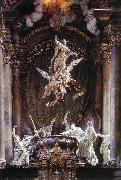
Sculptor, stuccoist, painter and architect, son of Hans Georg Asam. After working with his father, he was apprenticed to Anton Faistenberger in Munich to learn sculpture. He presumably accompanied his brother Cosmas Damian Asam to Rome (1711-13), where he studied works by Bernini. In 1724 he became a valet and court stuccoist to the Prince-Bishop of Freising and in 1730 a valet to the Elector of Bavaria. |
|
|
|
|
|
|
|
 |
Augustus Earle
|
|
Australian Painter , 1793-1838
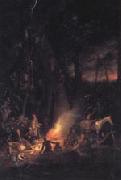
Nephew of Ralph Earl. He exhibited at the Royal Academy in London between 1806 and 1815, when he began travelling. He visited the Mediterranean between 1815 and 1817, and lived in North America (1818-20) and South America (1820-24). In February 1824, en route to India, he was accidentally abandoned on Tristan da Cunha for eight months. The passing ship that rescued him took him to Australia. Here he lived from 1825 until 1828, a period broken by a seven-month residence in New Zealand. During all of his voyages he made watercolour sketches, particularly of places 'hitherto unvisited by any artist', apparently with the intention of publishing a series of aquatints. These drawings, such as a Bivouac, Daybreak, on the Illawarra Mountains (1827; Canberra, N. Lib.), have a robust autobiographical quality. In Sydney he obtained a number of commissions, including a full-length portrait of Governor Sir Thomas Brisbane (1825-6; Sydney, Govt House). Earle returned to England in 1829 and produced a series of prints, Views in New South Wales, and Van Diemen's Land. |
|
 |
Augustus Egg
|
|
(2 May 1816 - 26 March 1863) was a Victorian artist best known for his modern triptych Past and Present (1858), which depicts the breakup of a middle-class Victorian family.
Augustus Egg was born in London on 2 May 1816 to Joseph and Ann Egg, and baptised in St James's Church, Piccadilly on 30 May 1816. He had an elder brother, George Hine Egg.
His father Joseph Egg was a wealthy gunsmith from the distinguished gun making family, who immigrated to London from Huningue, Alsace. Egg was educated in the schools of the Royal Academy, beginning in 1836. Egg was a member of The Clique, a group of artists founded by Richard Dadd and others in the late 1830s (c. 1837). Egg sought to combine popularity with moral and social activism, in line with the literary work of his friend Charles Dickens. With Dickens he set up the "Guild of Literature and Art", a philanthropic organisation intended to provide welfare payments to struggling artists and writers. He acted the lead role in a play written by Edward Bulwer-Lytton to raise funds for the organisation. His self-portrait in the role is in Hospitalfield House in Arbroath.
Egg's early paintings were generally illustrations of literary subjects. Like other members of The Clique, he saw himself as a follower of Hogarth. His interest in Hogarthian moral themes is evidenced in his paired paintings The Life and Death of Buckingham, depicting the dissolute life and sordid death of the Restoration rake. Yet his paintings often took a humorous look at their subjects, as in his Queen Elizabeth Discovers she is no longer Young (1848).
Unlike most other members of The Clique, Egg also admired the Pre-Raphaelites; he bought work from the young William Holman Hunt and shared ideas on color theory with him. His own triptych, known as Past and Present, was influenced by Hunt's work. The triptych depicted three separate scenes, one portraying a prosperous middle-class family and the other two depicting poor and isolated figures e two young girls in a bedsit and a homeless woman with a baby. The viewer was expected to read a series of visual clues that linked together these three scenes, to reveal that the prosperous family in the central scene is in the process of disintegrating because of the mother's adultery. The two outer scenes depict the separated mother and children a few years later, now living in poverty. The painting's use of flashback e the central scene is occurring in the past e has been seen as a precursor of cinema.
Egg was also an active organiser of exhibitions, being admired by fellow-artists for his dedication and fair mindedness. He was one of the organisers of the Manchester Art Treasures Exhibition in 1857. He was elected to the Royal Academy in 1860.
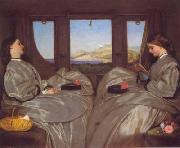
Always in poor health, Egg spent his later years in the warmer climate of continental Europe, where he painted Travelling Companions, an ambiguous image of two near-identical young women that has sometimes been interpreted as an attempt to represent two sides of the same person. A member of the circle of friends that included Dickens and Wilkie Collins, Egg features in their surviving correspondence. He participated, as actor and costume designer, in their amateur theatricals, which were often conducted for charitable purposes as noted above. In January 1857 he took a part in Collins's play The Frozen Deep, which starred Dickens and was performed at his home, Tavistock House (Egg played John Want, the ship's cook.) The production was also acted before Queen Victoria and then performed for charity. Dickens described Egg as a "dear gentle little fellow," "always sweet-tempered, humorous, conscientious, thoroughly good, and thoroughly beloved."
He died in Algiers, Algeria in 1863.
|
|
|
|
|
|
|
|
 |
Bartolome Esteban Murillo
|
|
Spanish
1618-1682
Bartolome Esteban Murillo Galleries
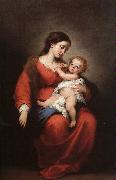
Murillo began his art studies under Juan del Castillo in Seville. Murillo became familiar with Flemish painting; the great commercial importance of Seville at the time ensured that he was also subject to influences from other regions. His first works were influenced by Zurbaran, Jusepe de Ribera and Alonso Cano, and he shared their strongly realist approach. As his painting developed, his more important works evolved towards the polished style that suited the bourgeois and aristocratic tastes of the time, demonstrated especially in his Roman Catholic religious works.
In 1642, at the age of 26 he moved to Madrid, where he most likely became familiar with the work of Velazquez, and would have seen the work of Venetian and Flemish masters in the royal collections; the rich colors and softly modeled forms of his subsequent work suggest these influences. He returned to Seville in 1645. In that year, he painted thirteen canvases for the monastery of St. Francisco el Grande in Seville which gave his reputation a well-deserved boost. Following the completion of a pair of pictures for the Seville Cathedral, he began to specialise in the themes that brought him his greatest successes, the Virgin and Child, and the Immaculate Conception.
After another period in Madrid, from 1658 to 1660, he returned to Seville. Here he was one of the founders of the Academia de Bellas Artes (Academy of Art), sharing its direction, in 1660, with the architect, Francisco Herrera the Younger. This was his period of greatest activity, and he received numerous important commissions, among them the altarpieces for the Augustinian monastery, the paintings for Santa Mar??a la Blanca (completed in 1665), and others. |
|
 |
BASCHENIS, Evaristo
|
|
Italian Baroque Era Painter, 1617-1677
Evaristo Baschenis (December 7, 1617 ?C March 16, 1677) was an Italian Baroque painter of the 17th century, active mainly around his native city of Bergamo. He was born to a family of artists. He is best known for still lifes, most commonly of musical instruments. This could explain his friendship with a family with notable violin makers from Cremona. Still-life depictiona were uncommon as a thematic among Italian painters prior to the 17th century. Baschenis, along with the more eccentric 16th century painter Milanese Arcimboldo, represents provincial outputs with idiosyncratic tendencies that appear to appeal to the discernment of forms and shapes rather than grand manner themes of religious or mythologic events. For Arcimboldo, the artifice is everything; for Baschenis, the items, man-made musical instruments, have a purpose and a beauty even in their silent geometry. One source for his photographic style of still life could be Caravaggio's early painting of peaches, or alternatively, Dutch paintings. The most faithful imitator of his style is a younger contemporary Bergamese, Bartolomeo Bettera. Baschenis is a contemporary of the Bergamese portrait artist, Carlo Ceresa, and appears to have been influential for the Modenese artist Cristoforo Munari. |
|
|
|
|
|
Bernard, Emile
|
|
French, 1868-1941
French painter and writer. He was the son of a cloth merchant. Relations with his parents were never harmonious, and in 1884, against his father's wishes, he enrolled as a student at the Atelier Cormon in Paris. There he became a close friend of Louis Anquetin and Toulouse-Lautrec. In suburban views of Asni?res, where his parents lived, Bernard experimented with Impressionist and then Pointillist colour theory, in direct opposition to his master's academic teaching; an argument with Fernand Cormon led to his expulsion from the studio in 1886. He made a walking tour of Normandy and Brittany that year, drawn to Gothic architecture and the simplicity of the carved Breton calvaries. In Concarneau he struck up a friendship with Claude-Emile Schuffenecker and met Gauguin briefly in Pont-Aven. |
|
|
|
 |
Bertel Thorvaldsen
|
|
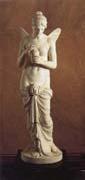
1770-1844 Copenhagen, He was a Danish/Icelandic sculptor. Thorvaldsen was born in Copenhagen in 1770 (according to some accounts, in 1768), the son of an Icelander who had settled in Denmark and there carried on the trade of a wood-carver. This account is disputed by some Icelanders, who claim Thorvaldsen was born in Iceland. Young Thorvaldsen attended Copenhagen's Royal Danish Academy of Art (Det Kongelige Danske Kunstakademi), winning all the prizes including the large Gold Medal. As a consequence, he was granted a Royal stipend, enabling him to complete his studies in Rome, where he arrived on 8 March 1797. Since the date of his birth had never been recorded, he celebrated this day as his "Roman birthday" for the rest of his life. Thorvaldsen's first success was the model for a statue of Jason, which was highly praised by Antonio Canova, the most popular sculptor in the city. In 1803 he received the commission to execute it in marble from Thomas Hope, a wealthy English art-patron. From that time Thorvaldsen's success was assured, and he did not leave Italy for sixteen years. In 1819 he visited his native Denmark. Here he was commissioned to make the colossal series of statues of Christ and the twelve Apostles for the rebuilding of Vor Frue Kirke (from 1922 known as the Copenhagen Cathedral) between 1817 and 1829, after its having been destroyed in the British bombardment of Copenhagen in 1807. |
|
 |
BOURSSE, Esaias
|
|
Dutch Baroque Era Painter, 1631-1672
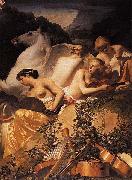
He was the youngest son of immigrants from Wallonia. His parents, Jacques Boursse and Anna des Forest, married in 1618 in Amsterdam. We know nothing more about the education of Esaias Boursse, other than the fact that he travelled to Italy in about 1650 to study the great Renaissance examples. No reminders of those examples is to be found in his work. In the past art historians have tried to place him among Rembrandt's pupils. There is no objective evidence at all to prove this though. Maybe this opinion has been inspired by the fact that the painters were neighbours in the Sint Antoniebreestraat in Amsterdam (nowadays called Jodenbreestraat, still housing the Rembrandt House Museum).
Boursse's financial position will not have been good, since in 1661 he sailed with the Verenigde Oostindische Compagnie, on the ship Amersfoort. It travelled to Ceylon (nowadays called Sri Lanka). Boursse drew the inhabitants, landscapes and city views, which have been preserved in an album which can be found in the print room of the Rijksmuseum Amsterdam. In 1663, the painter was back in Amsterdam.
In 1672, Boursse sailed with Verenigde Oostindische Compagnie again. The Amersfoort set sail on October 24 and on November 16 Boursse died at sea.
The life of Esaias Boursse is the story of a painter who could not earn a living by painting alone and therefore had to look for an alternative source of income. The fact that he was no exception is proven by the life stories of for example Jan Steen (who was also an innkeeper) and Johannes Vermeer (who was also an art dealer). A major difference though, is the fact that Steen and Vermeer had to feed and house a (large) family. Boursse seems to have remained unmarried and childless. Financially, Boursse's career was a success. He remains one of the highest paid artists in living memory. |
|
 |
Caesar van Everdingen
|
|
(1616/17, Alkmaar - buried October 13, 1678, Alkmaar), older brother of Allart van Everdingen and Jan van Everdingen, was a Dutch Golden Age portrait painter.
Caesar Pietersz van Everdingen also known as Caesar Boetius van Everdingen was educated in Utrecht, where he learned to paint from Jan Gerritsz van Bronckhorst.Caesar became a member of the painter's guild in Alkmaar in 1632. His first known painting dates from 1636. In 1648 he moved to Haarlem, where he joined the Haarlem Guild of St. Luke and the civic guard (or schutterij) there, where he met Jacob van Campen. From 1648 to 1650 He helped him with the decoration of the Oranje Zaal (Orange room) in Huis ten Bosch. In 1658 he moved back to Alkmaar where he started a workshop and took on pupils.
Many of his pictures are to be seen in the museums and private houses of the Netherlands. His pupils were Jan Theunisz Blanckerhoff, Adriaen Dekker, Hendrik Graauw, and Thomas Heeremans.Houbraken also lists two other pupils; Adriaen Warmenhuizen, and Laurens Oosthoorn.
|
|
|
|
|
|
|
|
 |
carl kylberg
|
|
Carl Oscar Kylberg, född 23 september 1878 på Vasängen i Fridene församling, död 6 januari 1952 i Stockholm, svensk konstnär och representant för Göteborgskoloristerna.
Carl Kylberg var son till kontorschef Gustaf Kylberg och friherrinnan Eleonora von Essen och storebror till konstnären Erik Kylberg. Hans fastrar och farbror var konstnärerna Regina Kylberg-Bobeck, Marina Kylberg och Hjalmar Kylberg. Farfadern Lars Wilhelm Kylberg var konstnär vid sidan av lantbruket på familjegodset Såtenäs i Västergötland.
Kylberg studerade först vid tekniska skolan i Stockholm och i Berlin för att bli arkitekt men övergick till måleri omkring 1900. Han studerade under en tid vid Valand i Göteborg som elev till Carl Wilhelmson. Hans verk kännetecknas ofta av ett glödande oljemåleri med starka färger och han avbildade ofta landskap och figurkompositioner på ett avskalat man??r. Under senare delen av sitt konstnärskap skapade han en mängd religiösa motiv.
Kring 1930-talet fick han sitt genombrott och han kom att ställa ut, förutom i Sverige även i Köpenhamn, Paris, London, Budapest och i USA men hans måleri var för många provocerande och 1938 gick regeringen in och stoppade ett köp av målningen Uppbrottet för Nationalmuseum i Stockholm.
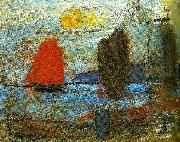
En av hans mest välkända målningar är Hemkomsten från 1938 som hänger på Göteborgs konstmuseum och som föreställer ett skepp i silhuett mot en nästan brinnande gul himmel och ett rödfärgat hav. Denna målning förevigades också 1978 på ett svenskt frimärke av valören 90 öre.
Sedan 1980-talet har många av hans tavlor sålts för rekordpriser vid olika internationella konstauktioner.
|
|
|


 Efimovich Arkhipov-576333.jpg)