|
|
|
|
|
|
|
|
|
|
|
|
|
|
|
|
|
|
|
|
|
|
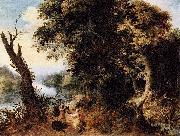 |
Abraham Govaerts
|
|
Abraham Govaerts (Antwerp, 1589 - 9 September 1626) was a Flemish Baroque painter who specialized in small cabinet-sized forest landscapes in the manner of Jan Brueghel the Elder and Gillis van Coninxloo.[1] He became a master in Antwerp's guild of St. Luke in 1607-1608, and subsequently trained several other painters in including Alexander Keirincx. Govaerts' paintings, such as A Forest View with the Sacrifice of Isaac (Alte Pinakothek, Munich), typically show diminutive history, mythological or biblical subjects within a Mannerist three-color universal landscape bracketed by repoussoir trees. The figures were often added by other artists, especially by members of the Francken family. |
|
|
|
|
|
 |
Aert de Gelder
|
|
Dutch
1645-1727
Dutch painter and draughtsman. He was the son of a wealthy Dordrecht family and probably became a pupil of Samuel van Hoogstraten in 1660. Apparently on the advice of van Hoogstraten, de Gelder moved to Amsterdam and entered Rembrandt workshop, possibly c. 1661. It is commonly assumed that he stayed there about two years. He was Rembrandt last pupil. After completing his apprenticeship, de Gelder returned to Dordrecht, where he worked for the rest of his long career. Considering that de Gelder was active for more than half a century, his output of just over 100 paintings seems low, probably because he was financially independent. Of those paintings accepted as by him, only 22 are dated, creating considerable problems in establishing a chronology.
|
|
 |
Agnes Goodsir
|
|
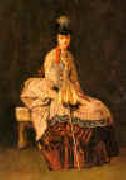
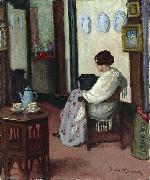
(18 June 1864, Portland, Victoria - 1939, France) was an Australian portrait painter who moved within lesbian circles in Paris in the 1920s and 1930s.
Goodsir was one of eleven children born to David James Cook Goodsir, Commissioner of Customs at Melbourne, and Elizabeth Archer.
Her early art training started with Arthur T. Woodward at the Bendigo School of Mines in the 1890s, and in 1899 some of her work was raffled in Bendigo to partly finance her study in Paris. The years following World War I saw a virtual exodus of Australian artists on a sort of Grand Tour to Paris, all intent on being part of the explosion of the arts taking place there. Painters like Rupert Bunny, Stella Bowen and Max Meldrum were drawn there by the appeal of the Left Bank. Others like Margaret Preston and Grace Crowley were inspired to develop in new directions by post-war Parisian art.
Goodsir attended the Academie Delecluse, the Academie Julian and then the Academie Colarossi. From about 1912 she shuttled between London and Paris, but finally settled in Paris at 18 Rue de l'Odeon. Her constant companion was Rachel Dunn, depicted in several of her paintings, such as The Chinese Skirt 1933, Girl with Cigarette 1925, The Letter 1926 and Morning Tea 1925.
Her work was acclaimed and exhibited at the New Salon, the Salon des Independants, and the Societe Nationale des Beaux Arts in Paris as well as at the Royal Academy and the Royal Institute in London. On a short visit to Australia in 1927 she exhibited at the Macquarie Galleries in Sydney and the Fine Arts Gallery in Melbourne. In 1938 four of her oils were shown at the sesquicentennial exhibition at the NSW National Art Gallery.
On her death in 1939, her paintings were left to her companion Rachel Dunn, who sent some 40 to Agnes's family in Australia and others to Australian galleries. |
|
 |
Agnolo Gaddi
|
|
Italian Early Renaissance Painter, ca.1345-1396
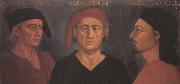
Son of Taddeo Gaddi. Through both his brother Giovanni and his father, Agnolo was heir to the Giottesque tradition and to a successful family enterprise, which he directed with enormous success up to the turn of the 15th century. He is first mentioned as a painter in 1369, when he assisted his brother Giovanni and Giovanni da Milano in decorations for Urban V (reg 1362-70) in the Vatican. Although he probably did not assume full responsibility for the workshop until his brother Giovanni death, he must have begun accepting his own commissions as early as the 1370s. The nature of his early work and whether it included an altarpiece dated 1375 (Parma, G.N., 435), however, remains a matter of debate. Logical or likely though it may be, the notion that this early activity developed out of his brother Giovanni still little-known art is hypothetical. Whereas the works grouped around Giovanni name are all small panels, Agnolo was an artist who, like his father, excelled in wall painting. Indeed, three monumental fresco cycles (see below), in the Castellani Chapel (painted c. 1384) and the choir (painted c. 1388-93) of Santa Croce, Florence, and the chapel of the Sacra Cintola (doc. 1393-5) in Prato Cathedral, constitute the artist most notable surviving works and offer a basis for reconstructing the content and chronology of his oeuvre. |
|
 |
Agnolo Gaddi
|
|
Italian Early Renaissance Painter, ca.1345-1396 |
|
|
|
 |
Akseli Gallen-Kallela
|
|
April 26, 1865 C March 7, 1931)
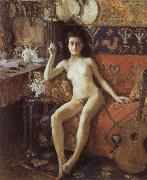
Gallen-Kallela was a Finnish artist and designer closely associated with notions of National Romanticism, especially relating to the region of Karelia, also a source of inspiration for the Finnish composer Jean Sibelius. Of particular influence was the collection of folk poems formed in the middle of the 19th century by Elias Lonrot. Following a national competition in 1891 Gallen-Kallela illustrated this national epic known as the Kaleval, the vivid images of which soon became widely known throughout Finland. He also made a significant contribution to the Finnish Pavilion at the Paris Exposition Universelle of 1900 in which he painted frescoes on Kalevala themes in the main dome, as well as designing textiles and furniture. His furniture designs were made by the Iris company, founded by a close friend, Louis Sparre. Like many other ventures associated with Arts and Crafts, the Iris company was concerned with the production of well-designed, well-made furniture and ceramics. Gallen-Kallela designs at Paris 1900 attracted considerable attention leading to the award of a number of Gold and Silver Medals at the exhibition. He worked in a wide range of design media, including ryiji rugs, which he modernized using geometric motifs derived from the Finnish landscape. His distinctive contribution to Finnish culture is preserved in the Gallen-Kallela Museum, which was originally built by him as a studio and family home between 1911 and 1913 and now contains a large body of his work, including paintings, graphics, textiles, jewellery, stained glass, and architectural designs.
|
|
 |
Albert Gallatin Hoit
|
|
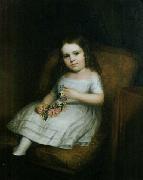
Albert Gallatin Hoit (December 13, 1809 - December 18, 1856) was an American painter who lived in Boston, Massachusetts. He painted portraits of William Henry Harrison, Daniel Webster and Brenton Halliburton.
Hoit was born in Sandwich, New Hampshire, December 13, 1809, to Gen. Daniel Hoit and Sally Flanders. Siblings included William Henry Hoit. Hoit graduated from Dartmouth College in 1829. He married Susan Hanson in 1838; children included Anna M. Hoit.
Hoit "devoted his life to portrait painting, first at Portland, Maine, in 1831, and then in Bangor and Belfast, Maine, and St. John's, N.B. until Boston, Mass., became his permanent home in 1839." He also travelled in Europe, "Oct. 1842 to July 1844, ... enjoying the galleries of art in Italy, Paris, and London." He created portraits of Pietro Bachi, Johanna Robinson Hazen, J. Eames, and others. He painted a portrait of Daniel Webster "for Paran Stevens, which hung for years in the Revere House, Boston, and now belongs to the Union League Club, New York."
He was affiliated with the Boston Artists' Association; and exhibited at the gallery of the New England Art Union in the 1850s. In 1848, he kept a studio on Tremont Row in Boston, and lived in Roxbury. By 1852, he'd moved his studio to Washington Street.
Hoit died in Jamaica Plain, December 18, 1856, at age 47.
|
|
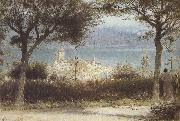 |
Albert goodwin,r.w.s
|
|
1845-1932
English painter. During the early 1860s Goodwin studied with Arthur Hughes and Ford Madox Brown, who predicted that his pupil would become 'one of the greatest landscape painters of the age'. Hughes and Brown impressed on Goodwin the Pre-Raphaelite principles of high finish, vivid colour and working directly from nature that inform his early landscape style, |
|
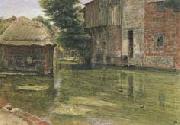 |
Albert Goodwin,RWS
|
|
1845-1932
English painter. During the early 1860s Goodwin studied with Arthur Hughes and Ford Madox Brown, who predicted that his pupil would become 'one of the greatest landscape painters of the age'. Hughes and Brown impressed on Goodwin the Pre-Raphaelite principles of high finish, vivid colour and working directly from nature that inform his early landscape style |
|
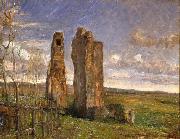 |
Albert Gottschalk
|
|
(3 July 1866 - 13 February 1906) was a Danish painter. He had a close connection, personally and artisticly, to the poets Johannes Jørgensen, Viggo Stuckenberg and Sophus Claussen.
Albert Gottschalk was born in Stege on the island of Møn. but later moved to Copenhagen. He was educated at the Royal Danish Academy of Fine Arts from 1882 to 1883 and under Peder Severin Krøyer at the Artists Studio Schools from hos from 1883 to 1888. He also studied privately with Karl Jensen and Karl Madsen.
Gottschalk was inspired by the Danish painter P.S. Krøyer as well as French art.
Gottschalk was ambitious, technically skilled, and he worked a long time with his motifs in his mind before painting them. He searched for his motifs in Denmark on his bicycle, and he found them often around Copenhagen. The paintings often look like they are quickly made sketches which was not recognised in Gottschalkes time. But today people find his works fresher and more timeless than art from that time normally is.
|
|
 |
Aleksander Gierymski
|
|
Warsaw 1850-1901 Rome, Brother of Maks Gierymski. He studied (1867) at the Warsaw Drawing Class, then (1868-73) at the Akademie der Bildenden Kenste in Munich under Georg Hiltensperger (1806-90) and Alexander Strehuber (1814-82), and later under Karl Theodor von Piloty. While in Munich he contributed illustrations to Polish, German and Austrian magazines. On a visit to Venice and Verona in 1871 he was especially impressed by the work of 15th-century Venetian artists; this new enthusiasm was reflected in his prize-winning painting of a subject set by the Munich Akademie, a scene from Shakespeare's Merchant of Venice (1872; destr., see Starzynski, pl. 4). After accompanying his dying brother Maks to various spa towns and other locations, he settled in Rome in mid-1874. Two genre scenes from this period, Roman Tavern and A Game of Mora (both 1874; Warsaw, N. Mus.), show the influence of Dutch painting. Gierymski remained in Italy until 1879, mostly resident in Rome. |
|
 |
Alexander Yakovlevich GOLOVIN
|
|
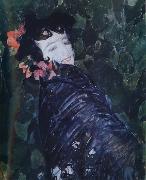
an important Russian artist and stage designer who designed sets for many productions by Sergei Diaghilev,1863-1930 |
|
 |
Alexandre Gabriel Decamps
|
|
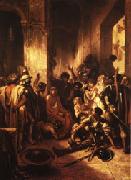
French Romantic Painter, 1803-1860.
Studied under Abel de Pujol.
Specializes in Orientalism.
Studied under Abel de Pujol. Specializes in Orientalism. French genre and historical painter, engraver, and lithographer. First known for his caricatures and illustrations, he turned to painting in thick impasto and strong color. One of his richest sources was the Middle East, which he depicted in vivid detail. |
|
 |
Alexandre-Gabriel Decamps
|
|
(March 3, 1803 - August 22, 1860) was a French painter.
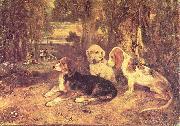
He was born in Paris. In his youth he travelled in the East, and reproduced Oriental life and scenery with a bold fidelity to nature that puzzled conventional critics. His powers, however, soon came to be recognized, and he was ranked along with Delacroix and Vernet as one of the leaders of the French school. At the Paris Exhibition of 1855 he received the grand or council medal. Most of his life was passed in the neighborhood of Paris. He was fond of animals, especially dogs, and indulged in all kinds of field sports. He died in 1860 in consequence of being thrown from a horse while hunting at Fontainebleau.
Decamps' style was characteristically and intensely French. It was marked by vivid dramatic conception, bold and even rough brushstrokes, and startling contrasts of color and of light and shade. His subjects embraced an unusually wide range. He availed himself of his travels in the East in dealing with scenes from Scripture history, which he was probably the first of European painters to represent with their true and natural local background. Of this class were his Joseph sold by his Brethren, Moses taken from the Nile, and his scenes from the life of Samson, nine vigorous sketches in charcoal and white.
Perhaps the most impressive of his historical pictures is Defeat of the Cimbri, representing the conflict between a horde of barbarians and a disciplined army. Decamps produced a number of genre pictures, chiefly scenes from French and Algerian domestic life, the most marked feature of which is humour. The same characteristic attaches to many of his numerous animal paintings; Decamps was especially fond of painting monkeys. His well-known painting The Monkey Connoisseurs satirizes the jury of the French Academy of Painting, which had rejected several of his earlier works on account of their divergence from any known standard. |
|
|
|
|
|
|
|
 |
Ambroise-Louis Garneray
|
|
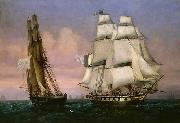
(19 February 1783 - 11 September 1857) was a French corsair, painter and writer. He served under Robert Surcouf and Jean-Marie Dutertre, and was held prisoner by the British for eight years.
Garneray was born in Paris (on Rue Saint-Andre-des-arts, in the Latin Quarter) on 19 February 1783. He was the elder son of Jean-François Garneray (1755-1837), painter of the king, who was pupil of Jacques-Louis David. At thirteen, he joined the Navy as a seaman, encouraged by his cousin, Beaulieu-Leloup, commander of the frigate Forte ("the Stout one"). Garneray sailed from Rochefort to the Indian Ocean with the frigate division under Sercey, to which the Forte belonged.
Garneray took part in the various campaigns of Sercey division and witnessed the hardship it met in the battle against Arrogant and Victorious. He then served in 1798 on the corvette Brûle Gueule ("Mouth burner"), which patrolled with the frigate Preneuse ("the Taker"). Returning from this campaign, the Brûle Gueule and Preneuse were chased by a British squadron comprising two ships of the line, one frigate and one corvette; the French flew into a creek near Black River whose shallow waters prevented the British from pursuing. The next day, the British squadron attacked; the French had established strong defensive positions by installing the unusable batteries of their ships ashore, and repelled the British squadron.
In 1799, Garneray was promoted to quartermaster and "first painter of the edge" on the Preneuse under captain Jean-Marthe-Adrien l'Hermite. The frigate was the last French official force in the Indian Ocean. This patrol went into trouble, in spite of an exceptional combat against the British ship of the line the Jupiter. Returning to Mauritius, her crew suffered from scurvy, and the Preneuse had to be kept quarantined and had to return to the British forces making the blockade of the island. Garneray escaped captivity by regaining the coast with the stroke. In spite of the disaster, Garneray kept longstanding admiration and friendship for to Lhermitte, whom he would continue to visit until his death 1826.
Garneray: Capture of Kent by SurcoufFor lack of official ships, Garneray joined the Confiance ("the Trust") of Robert Surcouf as an ensign, from April at December 1800. He took part in the capturing and boarding the Kent in October 1800. It was the only time where Garneray made money as a sailor. Upon returning from patrol, he invested his share in a slave trading ship, l'Union, on which he was a first mate.
He sailed on various trading ships during the peace of Amiens, after which he served aboard the Pinson ("the Finch"), a cutter based in Île Bourbon. He replaced the commander when he died, and was shipwrecked shortly thereafter. He then served on the corsair Tigre du Bengale and eventually on the frigate Atalante attached to the squadron of Linois. He later served on the Belle Poule ("beautiful chick"), and was aboard when she was captured by the British in March 1806. Wounded, Garneray was led in England and spent the eight following years on prison hulks off Portsmouth (on the Protee, the Couronne ("Crown") and the Vengeance. He was able to improve his standard of living by selling paintings to a British merchant.
A statement attributed to him goes: "But for piracy, I believe that I practiced about all kinds of navigation".
|
|
|
|
 |
Andre Gill
|
|
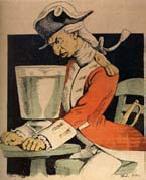
1840-1885,was a French caricaturist. Born Louis-Alexandre Gosset de Guines at Paris, the son of the Comte de Guines and Sylvie-Adeline Gosset, he studied at this city's Academy of Fine Arts. He adopted the pseudonym Andre Gill in homage to his hero, James Gillray. Gill began illustrating for Le Journal Amusant. Gill, however, became known for his work for the weekly four-sheet newspaper La Lune, edited by Francis Polo, in which he drew portraits for a series entitled The Man of the Day. He worked for La Lune from 1865 to 1868. When La Lune was banned, he worked for the periodical L'Eclipse from 1868 to 1876. |
|
 |
Andrea Di Giusto
|
|
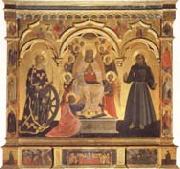
b Florence, c. 1400; d Florence, 2 Sept 1450
Italian painter. He was an eclectic minor Florentine master who was influenced by, and at different times imitated, the styles of Masaccio, Masolino, Lorenzo Monaco, Fra Angelico and Domenico Veneziano. In 1426 he was an assistant of Masaccio in the execution of the altarpiece for the Carmine church in Pisa (London N.G.; Naples, Capodimonte; Berlin, Gem?ldegal.; Malibu, CA, Getty Mus.; Pisa, Mus. N. & Civ. S Matteo) and painted its predella panels of the Legend of St Julian and the Charity of St Nicholas (Berlin, Gem?ldegal.). His name appears in the tax registers of the Florentine Archivio delle Decime from 1427 to 1447 and in the protocols of the Arte della Calimala in 1436, the same year in which he received 60 florins for an altarpiece (destr.) for S Lucia dei Magnoli. In 1437 he signed and dated the Assumption of the Virgin with SS Catherine and Francis (Florence, Accad.). His other dated works are a Virgin and Child with Four Saints (1435; Prato, Mus. Com.), which is a copy of Lorenzo Monaco's Monte Oliveto Altarpiece of 1410 (Florence, Pal. Davanzati); a Virgin and Child (1435; Florence, Villa I Tatti), a rustic interpretation of a Virgin and Child by Fra Angelico (Turin, Gal. Sabauda) |
|
|
|
 |
Anne-Louis Girodet de Roussy-Trioson
|
|
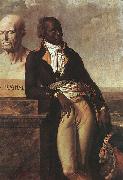
(also given as Anne-Louis Girodet de Roucy-Triosson, Anne-Louis Girodet-Trioson) January 5, 1767 - December 9, 1824), was a French painter and pupil of Jacques-Louis David, who was part of the beginning of the Romantic movement by adding elements of eroticism through his paintings. Girodet is remembered for his precise and clear style and for his paintings of members of the Napoleonic family.
|
|
 |
Anne-Louis Girodet-Trioson
|
|
1767-1824
French
Anne Louis Girodet Trioson Galleries
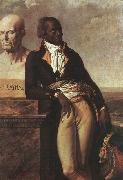
Girodet was born at Montargis. He lost his parents in early youth and the care of his inheritance and education fell to his guardian, M. Trioson, "medecin-de-mesdames," by whom he was in later life adopted and whose surname he took in 1812. He started in school by studying architecture and pursuing a military career. He later changed to the study of painting under a painter named Luquin, before entering the school of David. From 1789 to 1793 he lived in Italy where, at the age of twenty-two, he successfully competed for the Prix de Rome thus making a name for himself for his painting of the Story of Joseph and his Brethren. At Rome he painted his Hippocrate refusant les presents d'Artaxerxes and Endymion-dormant (presently held in the Louvre), work which was praised at the Salon of 1793. |
|
|
|
 |
antoine jean gros
|
|
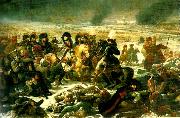
Baron Antoine-Jean Gros (16 March 1771 ?C 25 June 1835), also known as Jean-Antoine Gros, was both a French History and neoclassical painter.
Born in Paris, Gros began to learn to draw at the age of six from his father, who was a miniature painter, and showed himself as a gifted artist. Towards the close of 1785 Gros, by his own choice, entered the studio of Jacques-Louis David, which he frequented assiduously, continuing at the same time to follow the classes of the College Mazarin.
Bataille d´Aboukir, 25 juillet 1799, 1806, (detail).The death of his father, whose circumstances had been embarrassed by the French Revolution, threw Gros, in 1791, upon his own resources. He now devoted himself wholly to his profession, and competed (unsuccessfully) in 1792 for the grand prix. About this time, however, on the recommendation of the École des Beaux Arts, he was employed on the execution of portraits of the members of the National Convention, and disturbed by the development of the Revolution, Gros left France in 1793 for Italy. |
|
 |
Anton Graff
|
|
1736-1813
Swiss
Anton Graff Gallery
Swiss painter, active in Germany. He was a pupil of Johann Ulrich Schellenburg (1709-95) in Winterthur and continued his training with Johann Jakob Haid in Augsburg between 1756 and 1765. He worked for the court painter Leonhard Schneider (1716-62) in Ansbach from 1757 to 1759, producing large numbers of copies of a portrait of Frederick the Great (probably by Antoine Pesne). This was an important step in furthering his career, as were the months he spent in Regensburg (1764-5) painting miniatures of clerics and town councillors. He was court painter to the Elector Frederick-Christian of Saxe-Weimar in Dresden from 1766 and taught at the Hochschule der Bildende K?nste there. In 1771 he travelled to Berlin, where he painted portraits of Jakob Mendelssohn, Gotthold Ephraim Lessing and J. G. Sulzer. Sulzer introduced him at court, which resulted in many commissions. He was invited several times to teach at the Akademie der K?nste in Berlin, but he remained in Dresden. He often travelled to Leipzig, and in summer he frequently went to Teplitz (now Teplice, Czech Republic) and Karlsbad (now Karlovy Vary, Czech Republic); he also worked in Berlin on several occasions and returned to Switzerland for visits. |
|
 |
Anton Domenico Gabbiani
|
|
1652-1726
Italian
Anton Domenico Gabbiani Gallery
Italian painter. He first trained with the Medici court portrait painter Giusto Suttermans and then with the painter Vincenzo Dandini. On 20 May 1673 he arrived in Rome, where he studied for three years under Ciro Ferri and Ercole Ferrata at the Accademia Fiorentina. He responded in particular to the paintings of Pietro da Cortona and Carlo Maratti who were both to be important influences on him. Though not precocious, Gabbiani became one of the most noted painters from the Accademia. After a period in Venice (1678-9) with the portrait painter Sebastiano Bombelli, he was in Florence in 1680. By 1684, the year in which he executed an Annunciation (destr.) for the Palazzo Pitti, he was an independent painter. His first important public commission, the St Francis de Sales in Glory (1685) for the church of SS Apostoli, Florence (in situ), shows the influence of Maratti in its grandiose composition and that of Dandini in the treatment of figures. In Prince Ferdinando de Medici Gabbiani found a particularly loyal patron, and he painted his portrait, Ferdinando de Medici and his Musicians (c. 1685; Florence, Pitti). One of the works executed for Ferdinando was possibly a portrait of his sister, which Chiarini has identified with the painting of Anna Maria Luisa de Medici (c. 1685; Florence, Pitti). Further works from this period are the group portrait of Three Musicians (Florence, Pitti) at Ferdinando court and a Group of Courtiers (1685-90; Florence, Uffizi). |
|
|
|
 |
Anton Graff
|
|
1736-1813
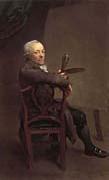
Swiss painter, active in Germany. He was a pupil of Johann Ulrich Schellenburg (1709-95) in Winterthur and continued his training with Johann Jakob Haid in Augsburg between 1756 and 1765. He worked for the court painter Leonhard Schneider (1716-62) in Ansbach from 1757 to 1759, producing large numbers of copies of a portrait of Frederick the Great (probably by Antoine Pesne). This was an important step in furthering his career, as were the months he spent in Regensburg (1764-5) painting miniatures of clerics and town councillors. He was court painter to the Elector Frederick-Christian of Saxe-Weimar in Dresden from 1766 and taught at the Hochschule der Bildende K?nste there. In 1771 he travelled to Berlin, where he painted portraits of Jakob Mendelssohn, Gotthold Ephraim Lessing and J. G. Sulzer. Sulzer introduced him at court, which resulted in many commissions. He was invited several times to teach at the Akademie der K?nste in Berlin, but he remained in Dresden. He often travelled to Leipzig, and in summer he frequently went to Teplitz (now Teplice, Czech Republic) and Karlsbad |
|
|
|
Apollonio di Giovanni
|
|
ca.1415-1465
Italian painter and illuminator. He was trained by illuminators in the circle of Bartolomeo di Fruosino and Battista di Biagio Sanguini (1393?C1451) and became a member of the Arte dei Medici e degli Speziali in 1442 and of the Compania di S Luca in 1443. Apollonio was influenced by Filippo Lippi, Lorenzo Ghiberti and Paolo Uccello. |
|
 |
ARCIMBOLDO, Giuseppe
|
|
Italian Mannerist Painter, ca.1530-1593
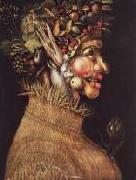
Italian painter, draughtsman and tapestry designer, active also in Austria and Bohemia. He came from a distinguished Milanese family that included a number of archbishops of the city; his father was the painter Biagio Arcimboldo. Giuseppe is first documented in 1549, working with his father for Milan Cathedral; he received payments until 1558 for supplying paintings, designs for an altar baldacchino and stained-glass windows for the cathedral: the Story of Lot and the Life of St Catherine in the south transept windows are usually attributed to him. He collaborated with Giuseppe Meda in designing the gonfalone of St Ambrose in Milan, probably sometime soon after 1558. In 1556 he received a commission to paint the south wall and vault of the south transept of Monza Cathedral, also in Lombardy, a work that must have been completed by 1562. Portions of a fresco of the Tree of Jesse on the south wall there can be attributed to him. In 1558 he was paid for designing tapestries for Como Cathedral (in situ). On the basis of stylistic comparison with the windows in Milan and the frescoes in Monza, the design of a tapestry representing St John the Baptist Preaching and Baptizing (Monza, Mus. Duomo) can be attributed to Arcimboldo. The Archbishop of Milan, Carlo Borromeo, probably paid for this tapestry. |
|
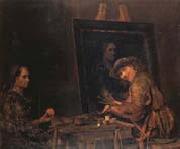 |
Arent De Gelder
|
|
1645-1727
was one of Rembrandt's last pupils while in Amsterdam, studying in his studio from 1661 to 1663. He was not only one of the most talented of Rembrandt's pupils, but also one of his most devoted followers, for he was the only Dutch artist to paint in the tradition of Rembrandt's late style into the 18th century. |
|
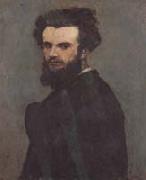 |
Armand guillaumin
|
|
French Impressionist Painter, 1841-1927
French painter and lithographer. He grew up in Moulins, but at 16 he returned to Paris to find work. Despite the opposition of his working-class family, he prepared for an artistic career while he supported himself in municipal jobs. He started drawing classes and then enrolled in the Academie Suisse, where he met Cezanne and Camille Pissarro. Guillaumin began his career as an avant-garde artist by exhibiting with them at the Salon des Refus's in 1863. |
|
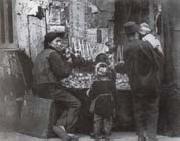 |
Arnold Genthe
|
|
German-born American Photographer, 1869-1942,German-born American photographer who received a doctorate in philology and linguistics from Jena University in 1894. As a photographer he was self-taught, and is probably best known for his pictures of Chinatown in San Francisco (1896-1906), where he opened a portrait studio in 1897, two years after arriving in America. Although his studio and equipment were destroyed in the 1906 earthquake, his prints survived and the Chinatown photographs were published in 1908. In that year he also started making autochromes. Genthe travelled widely in South America, Japan, and Germany, photographing landscapes and architecture, and in 1910 exhibited at the International Exhibition of Pictorial Photography in Buffalo organized by Alfred Stieglitz. Relocating to New York in 1911, he flourished as a celebrity portraitist. He also became celebrated for his dance photographs, published in The Book of Dance (1916) and Impressions of Isadora Duncan (1929). His autobiography, |
|
|
|
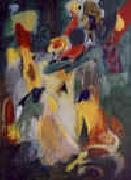 |
Arshile Gorky
|
|
Armenian
1904-1948
Arshile Gorky Gallery
Gorky was born in the village of Khorkom near Van, Turkey. It is not known exactly when he was born: it was sometime between 1902 and 1905. (In later years Gorky was vague about even the date of his birth, changing it from year to year.) In 1910 his father emigrated to America to avoid the draft, leaving his family behind in the town of Van. Gorky fled Van in 1915 during the Armenian Genocide and escaped with his mother and his three sisters into Russian-controlled territory. In the aftermath of the genocide, Gorky's mother died of starvation in Yerevan in 1919. Gorky was reunited with his father when he arrived in America in 1920, aged 16, but they never grew close. At age 31, Gorky married. He changed his name to Arshile Gorky, in the process reinventing his identity (he even told people he was a relative of the Russian writer Maxim Gorky).
In 1922, Gorky enrolled in the New School of Design in Boston, eventually becoming a part-time instructor. During the early 1920s he was influenced by impressionism, although later in the decade he produced works that were more postimpressionist. During this time he was living in New York and was influenced by Paul Cezanne. In 1927, Gorky met Ethel Kremer Schwabacher and developed a life lasting friendship. Schwabacher was his first biographer. |
|
|